Modern insolvency law has nothing in common with the grim reality depicted in certain Victorian novels of debtors subjected, not to insolvency proceedings, but to imprisonment even for indefinite periods. Since then, however, insolvency law has become a subject of extraordinary relevance and increasing intellectual fascination.
On the one hand, academics, policymakers, lawmakers, judges, and practitioners have reoriented this field of law in order to facilitate the rescue of distressed companies for as long as possible. On the other hand, this evolution has reshaped some of the most traditional categories of our legal culture. For example, this new deal has introduced into the toolbox of insolvency practitioners a great number of devices that combine the flexibility of contractual workouts with the capability of insolvency proceedings to bind even the most recalcitrant of creditors – as a result, in some cases the traditional distinction between “contract” and “proceedings” has blurred. The same tendency in favour of rescue has persuaded some lawmakers to enable distressed companies to depart from the traditional criteria according to which the debtor’s assets must be distributed – traditionally, these criteria were considered as non-negotiable – and even to waive a milestone of every company law according to which a company’s shareholders are the company’s residual claimants. A further consequence of this new approach is that in the case of group insolvencies there has been a tendency to mitigate the traditional single-entity approach according to which there ought to be one set of insolvency proceedings for each distressed company.
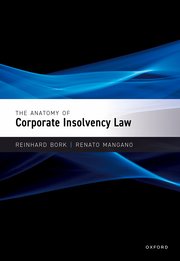
This finding does not relate to the insolvency law of a specific state, but to the world of all insolvency laws as a whole. Against this background, it can be an appealing task not to present and analyse a very specific insolvency law, but to ask a group of internationally outstanding scholars to examine certain core issues of insolvency law from an overarching, quasi supra-national perspective. Together with my co-editor Renato Mangano, I have now taken on this task in the book The Anatomy of Corporate Insolvency Law (Oxford University Press 2024).
This book focuses on corporate insolvency law and aims at explaining what corporate insolvency law is and how it works. In order to achieve this aim, corporate insolvency law is dissected into its main parts and analysed in the light of a comparative and functional approach. This choice of method implies that the chapters of the book are not devoted to any specific jurisdiction but concentrate on certain topics, in order to ascertain how the same problems may lead to different solutions in different jurisdictions; to what extent two solutions that appear dissimilar really diverge and, vice-versa, to what extent two solutions that appear similar really converge; and, last but not least, which of the solutions adopted in a specific jurisdiction deserve to be exported to another jurisdiction and under what conditions this legal transplant is possible.
The book consists of eleven chapters that cover the most relevant topics of corporate insolvency law, namely the nature of insolvency law, the definition of insolvency, debt restructuring outside formal insolvency proceedings, formal insolvency proceedings, security rights and creditors’ priority and ranking, transactions avoidance, directors’ duties, corporate groups, and cross-border insolvency law. The book also addresses the points where corporate insolvency law intersects with labour law and taxation law. The chapters are written by a team of specialists from three Continents and, more specifically, from China, Germany, Italy, Spain, the UK, and the US. In alphabetical order, these contributors are: Reinhard Bork, Laura Carballo Piñeiro, Edward J. Janger, Günter Kahlert, Shuguang Li, Renato Mangano, Jennifer Payne, and Johannes Richter. They are all pursuing the same goal with this publication, namely to create an understanding of what the cornerstones of insolvency law are, what the various legal systems have in common, and how they differ fundamentally. This basic understanding is important not only for fruitful discussion and academic analysis, but also for efficient and beneficial cooperation in insolvency practice across borders.
Reinhard Bork is Professor (ret.) at the University of Hamburg/DE. He is also Visiting Professor at Radboud University Nijmegen/NL, and Senior Research Fellow, Commercial Law Centre, Harris Manchester College, Oxford/UK.
 Corporate Finance Lab