Pre-insolvency proceedings, normative foundation and framework

A post by guest blogger Nicolaes W.A. Tollenaar

Legislation is currently being prepared, at both the European and the national levels, to introduce proceedings that aim to rescue ailing businesses before formal insolvency proceedings are begun. Such proceedings are commonly referred to as “pre-insolvency” proceedings. They provide for the right, outside formal insolvency proceedings, to propose a restructuring plan to creditors and other capital providers that, under certain circumstances, can be imposed upon opposing parties.

On 22 November 2016, as part of the Action Plan for a Capital Markets Union, the EC published a draft directive on preventive restructuring frameworks which, upon adoption, will compel the Member States to introduce pre-insolvency proceedings into their national systems. At the same time, the Dutch Government is working on a draft of the Continuity of Enterprises Act (Voorontwerp Wet Continuïteit Onderneming II), which seeks to introduce pre-insolvency proceedings in the Netherlands.

Dr. Nicolaes Tollenaar has kindly provided us with the following summary of his recent research regarding the normative foundation and framework of such pre-insolvency proceedings.

Continue reading “Pre-insolvency proceedings, normative foundation and framework”

The Mystery of Corporate Social Responsibility In a Market Economy

A post by guest blogger Penelope Bergkamp

The topic of corporate social responsibility (CSR) is old, but still much debated. For a long time, the dominant view has been that corporations do not have social responsibility, but the tide appears to have changed. Recently, both governments and corporations have explicitly endorsed CSR. But how can corporations pursue the common good in a competitive market economy? Clearly, by providing employment, goods and services, and entering into various transactions, corporations advance welfare, but in what sense other than normal commercial behavior can they be “socially responsible”? Continue reading “The Mystery of Corporate Social Responsibility In a Market Economy”

Brexit and Corporate Citizenship

hadrian

Recently, PM Theresa May indicated her willingness to pursue a “hard” Brexit, taking Great Britain completely out of the EU’s single market in order to reclaim full control of immigration and shake off the authority of the EU’s judges. The consequences of such a Brexit promise to be far-reaching, both for natural  and legal persons. With respect to the latter, time has come to really start thinking about a plan B (pun intended).

Continue reading “Brexit and Corporate Citizenship”

The Anatomy of Corporate Law

vesalius

This week the (already) third edition of the influential book The Anatomy of Corporate Law was published by Oxford University Press. The book provides the reader with a solid framework to understand corporate law from a comparative perspective. The following key jurisdictions are covered: US, UK, Brazil, Italy, France, Germany, and Japan. The general structure of the previous editions is maintained. The quality of the authors guarantees the quality of the work.

Continue reading “The Anatomy of Corporate Law”

2017 Heremans Lectures: Professor Larry DiMatteo (University of Florida) on the economic analysis of contract law

Closing Lecture, 2 March 2017 at 6 p.m. (Promotion Hall, Leuven)

The 2017 Dieter Heremans Lectures in Law & Economics at KU Leuven (Belgium) are given by Professor Larry A. DiMatteo (University of Florida).

You are kindly invited to the Closing Lecture, 2 March 2017 at 6 p.m. (Promotion Hall, Naamsestraat, Leuven, Belgium): Continue reading “2017 Heremans Lectures: Professor Larry DiMatteo (University of Florida) on the economic analysis of contract law”

The Walls Have Fallen, Run for the Keep

In one of our previous posts, we observed that the EU Court of Justice seems to be more lenient towards creditor protection measures in insolvency law than towards comparable measures in company law (see C‑594/14, Kornhaas). Moreover, the connecting factor for insolvency law (the so-called Centre of Main Interests, COMI) is not (entirely) freely selectable. Therefore, we concluded, Member States wishing to impose national requirements on non-domestic EU companies should make sure that these requirements are designed as rules of insolvency law.

A more detailed analysis of the Kornhaas judgment and its consequences for creditor protection mechanisms in both company and insolvency law can be found in G. Lindemans, “The Walls Have Fallen, Run for the Keep: Insolvency Law as the New Company Law for Third Parties”, ERPL 2016, vol. 5, 877-891, which was published earlier today.


You can’t have your cake and eat it too: on debt as equity

Een post door gastblogger Simon Landuyt

Debt and equity have in common that they are both provided to a company by an investor in return for a claim on its assets. For the creditor, the claim and the repayment date are fixed. On the other hand, the shareholder is a residual claimant. He will, in principle, only receive from the company to the extent the company’s assets exceed its liabilities. As a consequence, the claim of the shareholder is subordinated to the claim of the creditor. Therefore, at least in certain jurisdictions, it often happens that creditors or bankruptcy trustees try to qualify or “recharacterize” a rather vague financial contract of (another) investor into equity once the company gets into difficulties.

Continue reading “You can’t have your cake and eat it too: on debt as equity”

Harmonisation of insolvency law: a critique

Late last year, the European Commission publised its proposal on a new approach to business insolvency in Europe. This proposal was recently translated in all languages of the European Union. In a working paper, professor Eidenmüller (Oxford) strongly criticizes the conceptual framework of said proposal.

Continue reading “Harmonisation of insolvency law: a critique”

What are the duties of a shareholder?

Executive summary: same duties as everyone, but with a more punitive enforcement

In a recent post on the Oxford Business Law Blog Birkmose (Aarhus) and Möslein (Marburg) try to map shareholders’ duties: Continue reading “What are the duties of a shareholder?”

Are “common rules for all corporate forms” desirable or feasible?

Book II of the Belgian Company Code and the dangers of recycling antique legislative material

1.

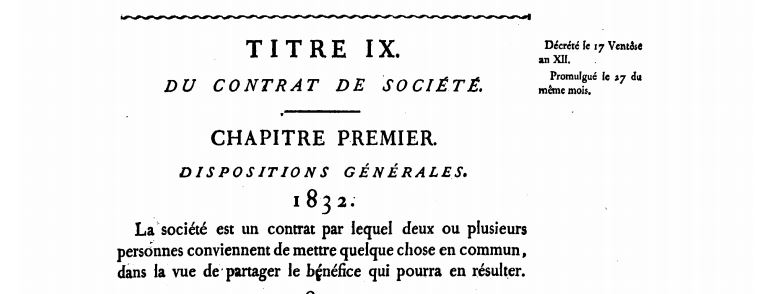
Art. 1832 – 1873  of the Code civil (Title IX of Book III) dealt with the “contract of partnership” (du contrat de société). The articles outlined the rules for the unincorporated partnership.

In Belgium this type of partnership is currently known as “société de droit common” or “maatschap”. Continue reading “Are “common rules for all corporate forms” desirable or feasible?”

Principles of cross-border insolvency law

In his new book, professor Bork sets out to identify the fundamental principles which govern cross-border insolvency law. The central thesis of the book is that cross-border insolvency rules of all kinds (e.g. the European Insolvency Regulation, the UNCITRAL Model Law, national laws such as Chapter 15 US Bankruptcy Code) are founded on, and indeed can be traced back to, some basic principles. This thesis, if proven correct, can be helpful for both deciding cases and shaping cross-border insolvency law through the use of a principle-based approach.

Continue reading “Principles of cross-border insolvency law”

Corporate Law after Brexit

2017 will not only be the first year of the Trump Presidency, but also the year in which the UK Government will (probably) initiate the formal procedure for withdrawing from the European Union (on possible negotiating strategies, read here). European Union law has a significant impact on corporate law and corporate insolvency law, also in the UK. In a recent paper (King’s Law Journalssrn), Michael Schillig examines the possible consequences of a Brexit on company and insolvency law. Continue reading “Corporate Law after Brexit”

A Christmas essay

reading-by-the-fire

A Christmas essay on the common law trust-origins of the corporate form, can be found here.

Corrigendum to Regulation (EU) 2015/848 on insolvency proceedings

A corrigendum regarding the applicability in time of the new Insolvency Regulation was published in the Official Journal of the European Union on 21 December 2016. The corrigendum reads as follows:

On page 56, Article 84(1):

for:

‘1. The provisions of this Regulation shall apply only to insolvency proceedings opened after 26 June 2017. Acts committed by a debtor before that date shall continue to be governed by the law which was applicable to them at the time they were committed.’,

read:

‘1. The provisions of this Regulation shall apply only to insolvency proceedings opened from 26 June 2017. Acts committed by a debtor before that date shall continue to be governed by the law which was applicable to them at the time they were committed.’.


The Liability of Legal Persons for Foreign Bribery

bribery

The OECD has recently published an interesting stocktaking report on the liability of legal persons for foreign bribery. This stocktaking report presents a chronology and a “mapping” of the features of the systems for liability of legal persons found in the 41 Parties to the Anti-Bribery Convention. The report can be consulted here.