Today, the Council gave the final stamp to a new EU law harmonising key aspects of insolvency rules across the EU. Member states have 33 months to transpose the directive into national law. From the press release of the Commission:
‘The EU common rules for insolvency proceedings include measures for:
Avoidance action: challenge transactions made by the debtor before the start of the bankruptcy procedure, thus protecting the insolvency estate against the illegitimate removal of assets.
Tracing assets: allow authorities, at the request of insolvency practitioners, to search bank account registers across the EU to identify assets of insolvent companies.
Pre-pack proceedings: enable the sale of a company in financial difficulty to be negotiated before the opening of formal proceedings and executed shortly after, while maintaining contracts which are essential for the continuation of the business.
Directors’ duties: require directors to file for insolvency within three months of financial distress, helping maximise recovery for creditors while allowing flexibility if alternative measures protect creditors equally.
Creditors’ committees: strengthen the involvement of individual creditors in the proceedings.
Transparency: require each country to publish clear factsheets on its insolvency laws, which will be made available on the EU’s e-Justice portal.’
Een post door professoren Arnoud Boot (Universiteit Amsterdam), Harm-Jan de Kluiver (Radboud) en Philip Wallage (Universiteit Amsterdam en Vrije Universiteit)
De uitdaging: Amerikaanse suprematie
De Amerikaanse suprematie in big tech en de groei en macht van de toonaangevende tech companies, de ‘Magnificent’ Seven (Microsoft, Meta, Alphabet, Apple, Nvidia, Amazon en Tesla), leidt niet slechts tot ongemak over onze afhankelijkheid daarvan, maar roept ook de vraag op hoe Europa zelf tech-ondernemers kan creëren. In hun bekende rapporten zoeken Letta en Draghi, maar ook Pieter Wennink, het antwoord in een combinatie van een beleid gericht op het bevorderen van de bloei van innovatieve ondernemingen in Europa en het sterk vergemakkelijken van de toegang tot de kapitaalmarkt.
De EU wil innovatieve ondernemingen en toegang tot de kapitaalmarkt bevorderen
Tekenend voor een poging die beide doelstellingen te combineren is recente EU-regelgeving (Richtlijn 2024/2810) die de groei van innovatieve ondernemingen wil stimuleren door het aantrekkelijker te maken om buiten de grote beurzen om, aandelen te plaatsen, en zo geld op te halen op meer informele beurzen (zogenaamde Multilateral Trading Facilities; MTF’s). De crux van de nieuwe EU-regel is dat ondernemingen het recht krijgen om bij verhandeling op zo’n beurs oprichters of andere kernaandeelhouders aandelen met meer stemrecht te geven dan die van de overige aandeelhouders. Op die wijze kunnen bijvoorbeeld oprichters de macht in de onderneming behouden, ook bij een toestroom van nieuwe aandeelhouders.
A post by Dr Warren de Waegh (University of Cape Town)
The most international kind of insolvency
There is arguably no line of business in which insolvencies are as international as in shipping. By their nature, ships are destined to be mobile and travel the seven seas. At the same time, ships are fictionally immobilised in the country of registration, often in an offshore open registry with faint connections to the shipowner’s country of origin, but with a favourable fiscal and regulatory regime. The choice of this registry is often pushed by ship financiers, who hold strong bargaining powers against the shipowner and enable the building and purchase of ships.
For its operation, shipowners typically resort to charterers, who sometimes may decide to register the ship in yet another country. Seafarers, the most vital links to the daily operation of the ship, are often recruited through shipping agencies in low-wages countries overseas. Along its voyages, the ship can be the object of various commercial and operational dealings in the different countries in which it calls port, e.g. with cargo interests, service providers and suppliers active in the port, pilotage and towage services, and shipyards. In addition, the ship can be faced with more inadvertent creditors, such as salvors, general average contributors, and creditors in tort following a collision or another maritime casualty.
When the shipowner becomes insolvent, all these sundry interests from different parts of the world suddenly face each other off. Against this highly international background, it is somewhat ironic that the administration of insolvencies of shipping companies or maritime insolvencies has proven to be challenging under existing cross-border insolvency instruments, such as the UNCITRAL Model Law on Cross-Border Insolvency (MLCBI) and the European Insolvency Regulation, recast (EIR). Given the pivotal role of shipping to global trade, the resulting chaos to the world economy can be enormous, as was illustrated most strikingly in the insolvency of the South Korean container shipping giant, Hanjin Shipping, now about ten years ago.
Jente Dengler (Monard Law) over tussentijdse financiering, boedelschulden en een merkwaardige lacune in het ‘stil faillissement’
Zonder liquiditeit valt elke onderneming stil, hoe beloftevol de doorstartplannen ook zijn. Voor de gerechtelijke reorganisatie voorziet de wetgever sinds jaar en dag een incentive om de motor draaiende te houden en tussentijds krediet te faciliteren: de zgn. ‘synthetische boedelschuld’. Vreemd genoeg ontbreekt dit voorrangsrecht in de toolkit van de Belgische pre-pack. Een gemiste kans, want nét daar is de nood het hoogst.
VZW’s en stichtingen spelen vandaag een centrale rol in uiteenlopende maatschappelijke en economische contexten. Sinds de beperking op economische activiteiten werd afgeschaft in 2019, is het uitkeringsverbod er de meest fundamentele regel, die deze rechtsvormen onderscheidt van vennootschappen. Ook het belangeloos doel heeft een prominentere betekenis gekregen in de juridische definitie van de VZW en de stichting. Toch rijzen er tal van vragen: Welke verrichtingen en welke doelen zijn toegelaten? Wat zijn de fiscale implicaties van het voeren van economische activiteiten? Wat is goed bestuur in VZW’s en stichtingen? En wie grijpt er in als het fout loopt?
Tijdens een studienamiddag op vrijdag 6 maart 2026 georganiseerde door het Jan Ronse Instituut voor vennootschaps – en financieel recht (KU Leuven) belichten academici en praktijkjuristen deze vragen vanuit een praktijkgerichte en kritische invalshoek. Daarbij komen onder meer de reikwijdte van het uitkeringsverbod en het belangeloos doel, de invulling van het verenigings- en stichtingsbelang, actiemogelijkheden bij wanbeheer en fiscale aandachtspunten aan bod.
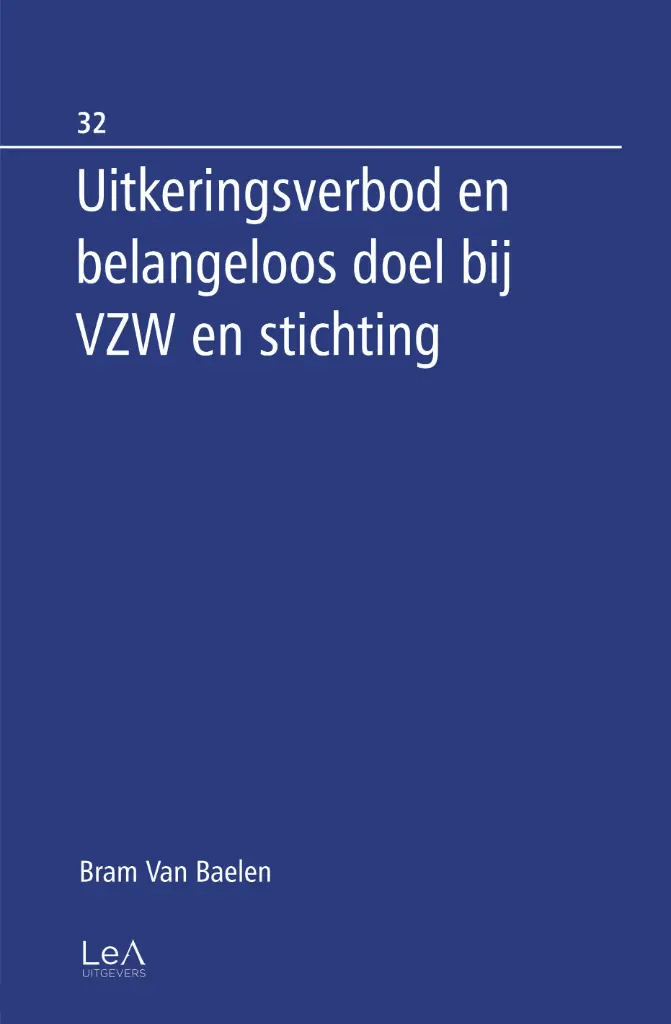
Rode draad doorheen de studienamiddag is de commerciële uitgave van het doctoraat van Bram Van Baelen, Uitkeringsverbod en belangeloos doel bij VZW en stichting, waarin deze kernbegrippen uitvoerig worden geanalyseerd als structurele fundamenten van het hedendaagse verenigings- en stichtingsrecht.
PROGRAMMA 13u00 Verwelkoming
Sofie Cools
13u10 Toegelaten verrichtingen en verboden uitkeringen binnen VZW’s en stichtingen
Bram Van Baelen
13u35 Het belangeloos doel van VZW en stichting
Sofie Cools
14u00 Het gebruik van VZW’s en stichtingen in hybride groepsstructuren
Lisa Bueken
14u25 De not-for-profitsector, het WER en het WVV: een evaluatie
16u20 Actiemiddelen bij wanbeheer in VZW en stichting
Matthias Wauters
16u45 Fiscaliteit van VZW en stichting
Bram Devolder
17u10 Q&A
17u20 Slotwoord
Koen Geens
17u30 Receptie
PRIJS De deelnameprijs bedraagt 215 EUR en omvat het boek Uitkeringsverbod en belangeloos doel bij VZW en stichting (winkelprijs 160 EUR). De documentatie wordt digitaal ter beschikking gesteld. Deelname via livestream is mogelijk.
Vincent Verlaeckt (Ondernemingsrechtbank Gent) over Cass. 1 december 2025, C.24.0339.N/1
1.
In een arrest van 1 december 2025 heeft het Hof van Cassatie zich uitgesproken over de problematiek van de aanvang van de termijnen tot het aanwenden van rechtsmiddelen tegen een vonnis inzake kwijtschelding van restschulden na faillietverklaring van natuurlijke personen.
Meer bepaald over de vraag of de kennisgeving bij gerechtsbrief een beroepstermijn doet aanvangen.
Een korte bloemlezing uit de geschiedenis van het insolventierecht toont hoezeer de kwijtschelding een recent gegeven is. Het is nog geen 30 jaar geleden dat de eerste vorm van schuldbevrijding haar intrede maakte in de Belgische rechtsorde met het verschoonbaarheidsregime in de Faillissementswet van ‘98. Daarvoor kon de insolvente schuldenaar levenslang achtervolgd worden door zijn schuldeisers. Het is zelfs nog maar een 150-tal jaar geleden dat hij gespaard wordt van de lijfsdwang.[1] Voorheen was het gebruikelijk dat insolvente schuldenaren strafrechtelijk vervolgd en opgesloten werden.
Nog verder terug in de tijd, in het oude Athene, werkten insolvente schuldenaren in schuldslavernij voor hun schuldeisers tot hun schulden volledig waren afbetaald. Het meest tot de verbeelding spreekt echter de situatie in de oude Romeinse Republiek, waar de derde tafel van de Twaaltafelenwet de insolvente schuldenaar het lot toebedeelde om in stukjes gehakt te worden door zijn schuldeisers in verhouding tot hun aandeel in zijn schulden.[2]
Het contrast met het heden kan dan ook niet groter zijn. Sinds de hervorming van het insolventierecht in 2018 worden alle restschulden van de gefailleerde kwijtgescholden bij de sluiting van het faillissement. Met de omzetting van de Herstructureringsrichtlijn in 2023 gebeurt dat zelfs automatisch, zonder dat de gefailleerde daartoe ook maar enige inspanning moet leveren.[3] In recordtijd is de kwijtschelding dan ook uitgegroeid van de uitzondering en een gunst, tot de regel en een recht.
A post by Rolef de Weijs, Luca Ratti and Johan Zwemmer
Towards a European pre-pack
In 2022 the European Commission presented a Proposal for the harmonisation of rules on pre-packs.[1] There were two central elements to the Commission’s proposal. First, all Member States should allow for pre-packs also with related parties. Second, existing EU protection of employees in case of pre-packs from the Transfer of Undertakings and Protection of Employees (TUPE) Directive[2] as developed by the CJEU would be abolished. The protection afforded under TUPE, as interpreted and developed by the CJEU, provides that employees transfer where the prepack is not aimed at the liquidation of the enterprise. As a consequence, employees will transfer most notably where a former shareholder or another related party acquires the business out of insolvency. In its unexplained attempts to give pre-packs a maximal boost, the Commission’s Proposal simply provided that all pre-packs would be deemed to be aimed at liquidation, which would mean that employees would never transfer on the basis of European law.
Under the European legislative process, the Commission has the right to initiate a directive, but it is up to the Council and the European Parliament to adopt a directive. The Council’s position has been somewhat unclear. The European Parliament pushed back against the Commission’s proposal for the harmonisation of rules on pre-packs with an amendment aimed at safeguarding employees’ protection. With these different positions, the Pre-pack Proposal entered the Trilogue phase, a process often referred to as the “back room of the back room.”[3] Since the Trilogue is not a transparent procedure, outsiders could not know in which direction the negotiations were heading. Like Schrödinger’s cat, we did not know whether employees’ protection was dead or alive while the Trilogue was ongoing.
The outcome of the Trilogue remains somewhat messy.[4] However, we conclude that, based on the text of the Pre-pack Directive, it is sufficiently clear that employees’ protection under TUPE is still intact and that employees will continue to transfer in the case of related-party pre-packs. The rather aggressive attempt to abolish employee protection in such cases has been unsuccessful.
A critical look by Veerle Colaert and Paul Dermine at the wrangling over the Russian assets held at Euroclear
While Trump’s original peace plan appears to be off the table, his proposal to create an investment fund with Russian assets at Euroclear continues to reverberate. Many European leaders are now calling even more forcefully for these assets to be transferred to Ukraine without delay, before the Trump administration mobilises them with its own agenda – and for its own benefit.
The urge to act quickly is understandable, but it is at least as important to keep a cool head. The United States clearly cannot seize the Russian assets held at Euroclear without the EU’s consent. And the reasons for the EU to leave those assets untouched remain as compelling as ever.
Naar goede gewoonte organiseren de masterstudenten van de grondige studie insolventierecht aan de Universiteit Antwerpen een studieavond onder begeleiding van prof. Melissa Vanmeenen.
Tijdens deze achttiende editie geven studenten toelichting bij een aantal thema’s uit het insolventierecht.
De studieavond gaat door op dinsdag 16 december 2025 om 19u, in lokaal C.103, Stadscampus UAntwerpen. (ingang via gebouw E naast Agora Café, Grote Kauwenberg 2 – volg de gang langs de sporthal en neem de trap naar de eerste verdieping)
Iedereen is welkom, gratis registreren kan via deze link.
A post by Rolef De Weijs, Luca Ratti & Johan Zwemmer
The EU wants to introduce pre-packs as a new type of insolvency procedure as a cure for financial failure. The French novel ‘Dr Knock’ provides a clear warning about doctors and medicines. Too much medicine weakens a healthy society. The following contains two spoilers. The first as to the plot of Dr. Knock. The second as to what will happen if the current EU Pre-Pack Proposal is adopted where it forces Member States to allow for Related Party Pre-Packs at the expense of creditors and employees.
The story of Dr Knock
The French novel Dr Knock (1924) by Romains tells the story of a doctor in a rural French town who wants to retire. The ambitious doctor Knock takes over the practice. The main problem is that the population is too healthy. Dr Knock, however, is of the opinion that healthy people are simply people that don’t realize they are sick. Dr Knock then offers each citizen a free consult, where he discusses new ailments and the risks of microbes. Soon half the population is under doctor supervision and the local hotel is turned into an emergency hospital.
The European Commission published its proposal for amending the Sustainable Finance Disclosure Regulation (SFDR) on 20 November 2025, accompanied by a Q&A. The proposal also explicitly amends the PRIIPS Regulation and is understood to implicitly “moot” certain provisions of the Taxonomy Regulation that reference the SFDR.
The SFDR has been discussed in a previous post as a disclosure regulation, adopted with the objective to harmonize the provision of sustainability-related information in individual and collective investment activities by financial market participants, financial advisers and financial products. The Commission proposal introduces a second objective: the creation of a harmonized categorization of sustainability-related products.
This post covers the three key proposed changes: a substantial reduction of the obligations for financial market participants, a limitation of the scope to “collective investment”, and a shift from a disclosure to a categorization framework.
The European Union seeks to harmonize European Insolvency Law. It has proposed a Directive for the harmonisation of certain aspects of insolvency law across Member States, including pre-packs.[1] The Commission’s ambition is to have this Proposal for a European pre-pack adopted as a Directive already by January 2026 (“the Proposal”).[2]
A pre-pack is a prepared insolvency procedure in which the sale of the business to a new owner is arranged prior to the opening of insolvency proceedings. Normally, this sale process takes place in a closed bidding environment and even in secrecy, in order not to disrupt the business and to ensure value maximization for creditors. Once the company is declared insolvent, the first thing that will typically happen is that the court appointed trustee will transfer the business to the highest bidder coming out of the sale process.[3]
Pre-packs have a tainted reputation, at least in jurisdictions where they are being used.[4] In part this is due to the highly legal nature of a pre-pack which overrides what people see in the street. In case of a prepack, a company as legal entity is declared insolvent by the court, but the business uninterruptedly continues to operate with a new owner. Creditors can no longer pursue their claim against the business (which is transferred to the new owner) and will have to file their claim with the trustee of the bankrupt entity. As long as pre-packs are conducted with outside parties, there is however little room for abuse. The procedure would then simply seek to ensure that the business is sold to the highest bidder in the interest of the joint creditors.[5] The prevention of damage caused by disruption by ensuring a confidential preparation only maximizes value. If this is what the pre-pack is all about, there is little cause for the tainted reputation.
Een post door Prof. mr. J.M. de Jongh (Erasmus Universiteit Rotterdam, raadsheer Ondernemingskamer)
De twee gezusters
De Belgische wettelijke geschillenregeling is een voorbeeld van een succesvolle ‘legal transplant’: de oorspronkelijke regeling uit 1995 was geïnspireerd door de Nederlandse geschillenregeling uit 1989. Opvallend genoeg heeft de Nederlandse geschillenregeling ruim 35 jaar een kwijnend bestaan geleid, terwijl haar Belgische evenknie tot op de dag van vandaag juist zeer succesvol is.
This Belgian Centre of Company Law (‘BCCL’) has published a paper with feedback on the ideas for a 28th Company Law Regime, as part of the Consultation which the Commission has organized on this topic.
The BCCL is a non-profit organization bringing together virtually all Belgian corporate law scholars and various Belgian corporate law practitioners with an academic affiliation.



 Corporate Finance Lab