Towards harmonisation of bank insolvency laws

The harmonisation of insolvency rules for European banks was recently put on the table by Germany’s finance minister Olaf Scholz, together with other measures (such as a European deposit insurance scheme) destined to advance the banking union (see his position paper on the goals of the banking union).  According to Minister Scholz:

The lack of harmonisation in this area complicates the resolution of banks with cross-border operations. This becomes particularly problematic when banks and creditors are better placed in proceedings under national insolvency legislation than they would be with a resolution in accordance with the Bank Recovery and Resolution Directive. When this happens, national insolvency legislation undercuts the provisions that are tailored to fit the specific set of interests at play when a bank is wound down.

What is more, the SRB also needs to take into account 19 different national insolvency regimes when performing a resolution due to the no-creditor-worse-off principle, which stipulates that no creditor may incur greater losses as a result of a resolution than they would have in national insolvency proceedings. This is complex, increases legal and compensation risks and results in groups of creditors receiving different treatment despite being fundamentally the same.

For this reason, we need a single European set of laws on bank insolvency.

Coincidentally (or not), a study on the differences between bank insolvency laws and on their potential harmonisation was recently published (the report and the executive summary can be found here). The abstract from the executive summary reads as follows:

 The resolution framework set out under Directive 2014/59/EU (‘BRRD’) provides EU Member States with comprehensive and harmonised arrangements to deal with failing banks at a national level, and is complemented in the euro area by the Single Resolution Mechanism Regulation (SRMR) that sets out a euro-area-wide resolution framework. But under EU law, unlike in the United States, resolution does not function as a standalone substitute for national insolvency proceedings. This study identifies the national insolvency procedures applicable to banks and analyses key differences between them, notably concerning the circumstances according to which the application of reorganisation or winding-up procedures is triggered, the ranking of liabilities, and the available tools to manage bank crises. By highlighting the differences that can be found in the legislative regimes applicable at national level and determining how these national insolvency regimes differ from the resolution regime as set out in the BRRD and SRMR, the study assesses the potential disadvantages that result from the lack of harmonisation of these bank insolvency regimes. Taking these disadvantages into account, policy options are outlined to address these divergences. The feasibility, benefits, obstacles and impact of these options are discussed. In terms of future revision of the current framework, more clarity and predictability of the applicable regime should be sought, particularly for medium-sized banks, with a holistic approach to reform that also takes into account related policies such as those on state aid control and deposit insurance.


Party Autonomy and Third-Party Protection in Insolvency Law

Papers from the INSOL Europe Academic Forum Annual Conference Athens, Greece, 3-4 October 2018

69356918_2596135720425106_922483357986586624_n - kopie (002)From 24 to 29 September 2019, the Inaugural YANIL Conference at 10 Years, the INSOL Europe Academic Forum and the INSOL Europe Annual Congress took place in Copenhagen, Denmark. The main topic of these conferences was the recently adopted European Restructuring Directive (what else?).


We will not try to summarise these discussions (a full report by Myriam Mailly, Jennifer Gant and Paul Omar will appear in the next edition of Eurofenix). We will try, however, to draw attention to the conference proceedings booklet of the Academic Forum 2018 which took place in Athens, Greece and which was published during this year’s conference. The topic of last year’s conference was “Party Autonomy and Third-Party Protection in Insolvency Law”, hence the title of this booklet. Continue reading “Party Autonomy and Third-Party Protection in Insolvency Law”

The Code of Capital – Video of the book presentation at KU Leuven

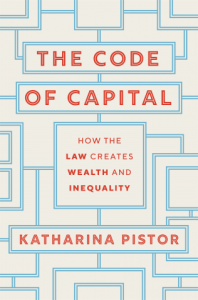
At the invitation of Corporate Finance Lab, Professor Katharina Pistor (Columbia Law School) presented her book The Code of Capital: How the Law Creates Wealth and Inequality at the KU Leuven in Brussels on November the 4th 2019. You can find the video’s of the introduction by Professor Dirk Heremans, the lecture by Professor Katharina Pistor and Belgian responses by Professor Ludo Cornelis, Professor Koen Geens and Professor Joeri Vananroye on YouTube.

Continue reading “The Code of Capital – Video of the book presentation at KU Leuven”

Next week: book presentation by Katharina Pistor in Brussels

The Code of Capital: How the Law Creates Wealth and Inequality

The Code of Capital by Katharina Pistor has been creating a lot of buzz over the last months. As announced previously, Professor Pistor will present her book next Monday November 4 at 16h30 at the Brussels campus of KU Leuven. Please note that because of the high number of attendants the presentation has been moved to Auditorium 2215 (Stormstraat 2 / 2  rue d’Assaut,  1000 Brussels).

screen_shot_0A short overview of the book by Professor Pistor herself can be found here (ProMarket, the blog of the Stigler Center at the University of Chicago). See here for an interview with her (Völkerrechtsblog). In a review on Law and Political Economy, Professor Samuel Moyn (Yale) writes: Continue reading “Next week: book presentation by Katharina Pistor in Brussels”

Agency Theory in the 21st Century

Conference at Maastricht University, October 25th. 2019

The Institute for Corporate Governance and Innovation Policies (ICGI) and Institute for Transnational Legal Research (METRO) at Maastricht University will host next Friday an interdisciplinary conference on ‘AGENCY THEORY IN THE 21st CENTURY’ at the Faculty of Law in Maastricht with Damla Bos (Maastricht University), David Cabrelli and Ewa Kruszewska (The University of Edinburgh), Joeri Vananroye (KU Leuven), Jean-Philippe Robé (SciencesPo Law School), Constantijn van Aartsen (Maastricht University) an Mieke Olaerts (Maastricht University).

Agency theory – the economic analysis of relationships between agents and principals – is influential and has spread well beyond its economic roots into a variety of disciplines, including law, political science, sociology, corporate governance and finance. It is used by scholars to design efficient institutions, structure individual incentives, prevent corporate corruption and compare institutional arrangements. Reliance on agency theory in these areas has, unfortunately, not prevented corporate scandals and suboptimal rates of trust in business and other institutions. The overarching aim of this conference is to address these issues in an interdisciplinary and international setting.

Programme

10.00-10.30 Registration & coffee
10.30-10.50 Introduction – Damla Bos, LLM – Maastricht University
10.50-11.40 Prof. David Cabrelli and Dr. Ewa Kruszewska – The University of Edinburgh
“The Limits of Agency Theory”
11.40-12.30 Prof. Joeri Vananroye – KU Leuven
“The Blind Spots of Agency Theory in Corporate Finance Law”
12.30-13.20 Lunch Break in room B0.006
13.20-14.10 Dr. Jean-Philippe Robé – SciencesPo Law School“Being Done with Milton Friedman”
14.10-15.00 Constantijn van Aartsen, LLM – Maastricht University“Agency Theory in the 21st Century: Legitimate, Reductionist and Overapplied”
15.00-15.30 Coffee break
15.30-17.00 Roundtable discussion
17.00-17.30 Closing – Prof. Mieke Olaerts – Maastricht University


Who’s afraid of the WTO?

A post by guest blogger Marie Parys

In August 2019, the US national security advisor visited the UK bearing the news of a trade deal. Perhaps not as conspicuous as it was odd was his statement that a future US-UK free trade agreement could be done on a “sector-by-sector-basis”. WTO rules decree that legal free-trade agreements must cover “substantially all trade”. This renders sectoral trade liberalization impossible. Or does it? Despite Prime Minister Boris Johnson conceding that negotiating a UK-US free trade agreement will be a “tough old haggle”, he has stated that it is the “single biggest deal” the UK needs to do following Brexit. Would the UK and the US be willing to flaunt WTO rules to get to the golden goose of an albeit gradual free trade agreement? Are WTO rules binding and enforceable, and why do most Members follow recommendations of the WTO dispute settlement system? In other words: how sharp are the WTO’s teeth and why do they bite? Continue reading “Who’s afraid of the WTO?”

The Road Towards Good Bankruptcy Governance: A Comparative Law and Economics Perspective

Papers from the INSOL Europe Academic Forum Annual Conference Athens, Greece, 3-4 October 2018

In the recently issued conference proceedings booklet “Party-Autonomy and Third Party Protection in Insolvency Law”, I published a paper called “The Road Towards Good Bankruptcy Governance: A Comparative Law and Economics Perspective”. The paper seeks to start the discussion on the topic of good bankruptcy (or insolvency) governance and to inspire idealistic researchers to become involved in this discussion. Three key aspects of good bankruptcy governance were dealt with in this paper.

First, an attempt was made to define the concept of “good bankruptcy governance”. This was later narrowed down to the following question: “In whose interest should the management of a corporation or insolvency estate act?”. A short comparative analysis of the US, the UK, Belgium and the Netherlands did not provide a clear answer.

However, some room for common ground could be found by Continue reading “The Road Towards Good Bankruptcy Governance: A Comparative Law and Economics Perspective”

‘Sometimes you need to talk to a three year old so you can understand life again’

Third anniversary of Corporate Finance Lab

Corporate Finance Lab celebrates today its third anniversary with a legacy of more than 500 posts.  For what it is worth, the most-read posts of all-time are:

In English:

In Dutch: 
Continue reading “‘Sometimes you need to talk to a three year old so you can understand life again’”

Limits to Group Structures and Asset Partitioning in Insolvency

The 800-Pound Gorilla. Limits to Group Structures and Asset Partitioning in Insolvency, Preadviezen / Reports 2018

The website of the Netherlands Association for Comparative and International Insolvency Law (NACIIL) has published in open access the reports (“preadviezen”) on Limits to Group Structures and Asset Partitioning in Insolvency.

This book contains reports prepared by prof. R. Squire (US), prof. J. Vananroye, A. van Hoe and dr. G. Lindemans (Belgium), prof. F.M.J. Verstijlen and A. Karapetian (Netherlands) and A.L. Jonkers (Netherlands). From the introduction to reports by the NACIIL board:

“In insolvency procedures, administrators have to accept the estate as they find it. Furthermore, administrators are commonly appointed in the proceeding as to a specific legal entity and have to respect the separate legal personality. By means of limited liability and separate legal personality, groups can incorporate in ways where liabilities and assets are allocated in different legal entities. This creates room for opportunism, especially in relation to creditors.

The 2018 NACIIL annual reports focus on the theme ‘Limits to Group Structures and Asset Partitioning in Insolvency’. This theme encompasses two related topics at the intersection of corporate law and insolvency law: (1) the artificial subdivision of enterprises over different legal entities (asset partitioning) and (2) selective perforation by means of guarantees. Continue reading “Limits to Group Structures and Asset Partitioning in Insolvency”

The Code of Capital: How the Law Creates Wealth and Inequality 

KU Leuven Campus Brussels | Monday 4 November 2019

9780691178974Professor Katharina Pistor (Columbia Law School) presents on Monday 4 November 2019 in Brussels her book The Code of Capital on how the law shapes the distribution of wealth.

This book develops i.a. the topics which Professor Pistor touched upon in her Heremans Lectures as Global Law Professor at the KU Leuven in 2016.

“This is a fascinating book that demonstrates how the rights of capital have been entrenched in the international legal system. The Code of Capital opens the way for a thoughtful discussion about the treaties on capital flows and privileges that need to be rewritten. A must-read.”

Thomas Piketty

Programme

16.30: Welcome by Professor Dirk Heremans (emeritus KU Leuven)

16.40: Lecture by Professor Katharina Pistor (Columbia Law School)

17.40: Belgian responses by

  • Professor Koen Geens (KU Leuven and Minister of Justice of Belgium)
  • Professor Ludo Cornelis (emeritus VUB)
  • Professor Joeri Vananroye (KU Leuven)

18.10: Q&A

18.30: End

Venue Continue reading “The Code of Capital: How the Law Creates Wealth and Inequality “

Call for proposals: Corporate & Organizational Decision-Making

By: Business & Liability Research Network (Leiden University)

The Business & Liability Research Network (BLRN) – a partnership between the Company Law department and the Business Studies department of the Leiden Law School – is launching its call for proposals for a new book project on the topic of Corporate & Organizational Decision-Making.

The Business & Liability Research Network

BLRN focuses on innovative and multidisciplinary research in the areas of (i) Good Corporate Governance, (ii) Distress & Insolvency and (iii) Future Business Structures. It was launched in 2018 with an opening conference on “Business Resilience”, which proved to be the prelude to a successful first year.

The network offers the possibility to bring together different research areas (legal and business research) as well as practice and the academic world, leading to innovative perspectives on current issues.

BLRN Book Project

The topic of decision-making in corporations and organizations is receiving increased attention due to the impact of technological developments, discussions on corporate governance and practical examples of (inadequate) decision-making processes. In this project, BLRN aims to highlight corporate & organizational decision-making from a multidisciplinary perspective. From both a legal and business perspective, research will be conducted within the sphere of the three research areas of BLRN: (i) Good Corporate Governance, (ii) Distress & Insolvency and (iii) Future Business Structures. This includes, for example, the relationship between corporate governance and entrepreneurship, the way in which various actors should act during insolvency and the impact of technological developments on a company. Continue reading “Call for proposals: Corporate & Organizational Decision-Making”

Can Nudging Consumers Help Promote Corporate Social Responsibility?

Governments around the world are trying to determine how to effectively promote corporate social responsibility (CSR). It has proven to be hard to regulate for CSR, so the focus has been on other policy initiatives. On the supply side, in response to calls from governments, corporations have adopted codes of conduct and related programs to promote CSR. In the eyes of CSR activists, these efforts have produced limited progress.

Attention is also being paid to the demand side of the equation. If consumers prefer socially produced goods, corporations will have incentives to adopt strong CSR programs. Behavioural sciences have suggested less interventionist ways to steer consumer choice towards socially responsible choices, in particular through various forms of nudging and social norms. Continue reading “Can Nudging Consumers Help Promote Corporate Social Responsibility?”

The New Bargaining Theory of Corporate Bankruptcy and Chapter 11’s Renegotiation Framework

A post by guest blogger Professor Anthony J. Casey (University of Chicago)

The prevailing theory of corporate bankruptcy law states that its purpose is to vindicate or mimic the agreement that creditors would have reached if they had bargained with each other to write their own rules. That idea – the Creditors’ Bargain theory – has held a central place in the minds of lawyers, judges, and scholars for almost forty years. At the same time, Creditors’ Bargain theorists have struggled to explain what actually prevents creditors from bargaining with each other and how efficient rules that interfere with creditors’ bargained-for rights fit into the theory.

Meanwhile, in other areas of the law, scholars have long recognized the limits of hypothetical contract theories. Notably, scholars have shown that when parties have limited or asymmetric information and incentives to bargain strategically, their contracts will be incomplete in ways that the law cannot remedy with a hypothetical contract. Bankruptcy scholars have never squarely addressed this challenge.

Taking aim at these issues, my article, The New Bargaining Theory of Corporate Bankruptcy and Chapter 11’s Renegotiation Framework, proposes a new law-and-economics theory of corporate bankruptcy. Continue reading “The New Bargaining Theory of Corporate Bankruptcy and Chapter 11’s Renegotiation Framework”

Aanbevolen (zomer)lectuur

De zomerperiode is het ideale moment om nieuwe inzichten op te doen. Recent zijn twee boeken verschenen die daartoe zeker de nodige inspiratie leveren. Het eerste boek is van de hand van professor Pistor (Columbia University) en is getiteld The Code of Capital How the Law Creates Wealth and Inequality. Het tweede boek is de monumentale studie van professor Cornelis (VUB) gewijd aan de openbare orde. Continue reading “Aanbevolen (zomer)lectuur”

Donkere wolken boven GROG: het arrest Plessers

In het jongste nummer van de Juristenkrant (nr. 391, 12 juni 2019) bespreken Stan Brijs en ik het arrest Plessers (zie hierover eerder op deze blog). Dit arrest stelt de verhouding tussen het insolventierecht en het arbeidsrecht op scherp. Continue reading “Donkere wolken boven GROG: het arrest Plessers”