De waardering van aandelen in de context van de geschillenregeling is een evergreen van het vennootschapsrecht. In een voor de rechtspraktijk belangrijk arrest van 16 januari 2020 (C.19.0096.N/3) zet het Hof van Cassatie enkele duidelijke principes uiteen, in de context van een vordering tot uitsluiting. Het arrest is geveld met toepassing van het Wetboek van Vennootschappen, maar de principes behouden hun gelding onder het Wetboek van vennootschappen en verenigingen. Continue reading “Cassatie over de waardering van aandelen bij de vordering tot uitsluiting”
Author: Arie Van Hoe
Arie Van Hoe, lawyer (Cresco) - corporate law, insolvency law, ESG.
Cassatie over (buiten)gewone schuldvorderingen in de opschorting: algemeen pandbeding volstaat
Wie als schuldeiser in een procedure van gerechtelijke reorganisatie belandt, doet er goed aan over een buitengewone schuldvordering in de opschorting te beschikken. Zoniet riskeert hij/zij met een fikse haircut geconfronteerd te worden in het reorganisatieplan. In het verleden heeft de afbakening tussen gewone en buitengewone schuldvorderingen aanleiding gegeven tot de nodige discussie in rechtspraak en rechtsleer. Ook de wetgever heeft zich herhaaldelijk met deze kwestie ingelaten. In een arrest van 16 januari 2020 (C.19.0294.N/1) heeft het Hof van Cassatie voor de praktijk belangrijke nadere toelichting gegeven. Continue reading “Cassatie over (buiten)gewone schuldvorderingen in de opschorting: algemeen pandbeding volstaat”
Je est un autre: Cassatie over belastingen, simulatie en rechtspersoonlijkheid
Op deze blog wordt veel over rechtspersoonlijkheid en weinig over belastingen geschreven. Rechtspersoonlijkheid en belastingen zijn echter nauw verbonden. De juridische techniek van de rechtspersoonlijkheid wordt immers gretig gebruikt voor fiscale doeleinden, waarbij het zelden de bedoeling is van de belastingplichtige meer belastingen te betalen. Belgen (m/v, Waal/Brusselaar/Vlaming) schijnen hier goed (minstens zeer bedreven) in te zijn. Het arrest van 2 januari 2020 (F.18.0074.N/1) van het Hof van Cassatie zal dan ook menig lezer van deze blog interesseren. Continue reading “Je est un autre: Cassatie over belastingen, simulatie en rechtspersoonlijkheid”
Cassatie over de strafrechtelijke verantwoordelijkheid van rechtspersonen
In een belangrijk arrest van 17 december 2019 (P.19.0845.N/7) heeft het Hof van Cassatie toelichting gegeven bij de materiële en morele toerekenbaarheid van misdrijven aan rechtspersonen. Artikel 5, eerste lid, Strafwetboek bepaalt dat een rechtspersoon strafrechtelijk verantwoordelijk is voor de misdrijven die hetzij een intrinsiek verband hebben met de verwezenlijking van zijn doel of de waarneming van zijn belangen, of die, naar blijkt uit de concrete omstandigheden, voor zijn rekening zijn gepleegd. De invulling van deze voorwaarden in de onstoffelijke context van rechtspersonen staat garant voor aangename discussies en uitgebreide conclusies. Continue reading “Cassatie over de strafrechtelijke verantwoordelijkheid van rechtspersonen”
Reparatie van de cap – bis
In een eerdere post wees dr. Gillis Lindemans op een bug in de cap. Zoals bekend, geldt de cap enkel nog voor toevallige lichte fouten (art. 2:57, § 3, 1°), hetgeen het revolutionair karakter ervan sterk uitholt. Evenwel voorziet art. 2:57, § 1 WVV vandaag nog steeds uitdrukkelijk dat de cap van toepassing is op de faillissementsaansprakelijkheid wegens kennelijk grove fout (art. XX.225 WER) en de faillissementsaansprakelijkheid wegens wrongful trading (art. XX.227 WER). Volgens dr. Lindemans kan een kennelijk grove fout echter nooit een toevallige lichte fout zijn en staat ook de voortzetting van een reddeloze onderneming op gespannen voet met het concept toevallige lichte fout. Continue reading “Reparatie van de cap – bis”
Suggesties voor onder de kerstboom
Het is de tijd van het jaar om pakjes onder de kerstboom te leggen. Wie familieleden of vrienden met bijzondere interesse in het insolventierecht heeft (innige deelneming), weet zich dit jaar van keuzestress bespaart. Zeer recent zijn immers twee indrukwekkende boeken verschenen die het famielilid/de vriend(in) in kwestie de volledige kerstvakantie zoet zullen houden. Beide werken, en hun auteurs, verdienen het even in de spotlights geplaatst te worden. Continue reading “Suggesties voor onder de kerstboom”
Towards harmonisation of bank insolvency laws
The harmonisation of insolvency rules for European banks was recently put on the table by Germany’s finance minister Olaf Scholz, together with other measures (such as a European deposit insurance scheme) destined to advance the banking union (see his position paper on the goals of the banking union). According to Minister Scholz:
The lack of harmonisation in this area complicates the resolution of banks with cross-border operations. This becomes particularly problematic when banks and creditors are better placed in proceedings under national insolvency legislation than they would be with a resolution in accordance with the Bank Recovery and Resolution Directive. When this happens, national insolvency legislation undercuts the provisions that are tailored to fit the specific set of interests at play when a bank is wound down.
What is more, the SRB also needs to take into account 19 different national insolvency regimes when performing a resolution due to the no-creditor-worse-off principle, which stipulates that no creditor may incur greater losses as a result of a resolution than they would have in national insolvency proceedings. This is complex, increases legal and compensation risks and results in groups of creditors receiving different treatment despite being fundamentally the same.
For this reason, we need a single European set of laws on bank insolvency.
Coincidentally (or not), a study on the differences between bank insolvency laws and on their potential harmonisation was recently published (the report and the executive summary can be found here). The abstract from the executive summary reads as follows:
The resolution framework set out under Directive 2014/59/EU (‘BRRD’) provides EU Member States with comprehensive and harmonised arrangements to deal with failing banks at a national level, and is complemented in the euro area by the Single Resolution Mechanism Regulation (SRMR) that sets out a euro-area-wide resolution framework. But under EU law, unlike in the United States, resolution does not function as a standalone substitute for national insolvency proceedings. This study identifies the national insolvency procedures applicable to banks and analyses key differences between them, notably concerning the circumstances according to which the application of reorganisation or winding-up procedures is triggered, the ranking of liabilities, and the available tools to manage bank crises. By highlighting the differences that can be found in the legislative regimes applicable at national level and determining how these national insolvency regimes differ from the resolution regime as set out in the BRRD and SRMR, the study assesses the potential disadvantages that result from the lack of harmonisation of these bank insolvency regimes. Taking these disadvantages into account, policy options are outlined to address these divergences. The feasibility, benefits, obstacles and impact of these options are discussed. In terms of future revision of the current framework, more clarity and predictability of the applicable regime should be sought, particularly for medium-sized banks, with a holistic approach to reform that also takes into account related policies such as those on state aid control and deposit insurance.
Save the date – Colloquium insolventierecht op 7 februari 2020
Op 7 februari 2020 wordt in Brussel een studienamiddag georganiseerd over actuele knelpunten en tendensen in insolventie. Het initiatief daartoe wordt genomen door de rechters in ondernemingszaken van de Nederlandstalige Ondernemingsrechtbank Brussel, in samenwerking met de Nederlandse Orde van Advocaten bij de Balie te Brussel en de Unie der Rechters in Ondernemingszaken van België. Volgende onderwerpen staan op het programma Continue reading “Save the date – Colloquium insolventierecht op 7 februari 2020”
Ook juristen dragen verantwoordelijkheid voor ongelijkheid
Naar aanleiding van het geslaagde en gesmaakte bezoek van professor Pistor, verscheen een bijdrage in de opiniesectie van De Tijd. Enkele citaten:
In deze goed gedocumenteerde vaststelling vinden we onmiddellijk de verklaring voor de ongemakkelijke afwezigheid van juristen in het ongelijkheidsdebat. Het zijn juristen die bewust of onbewust de maatschappelijk ongelijkheid vormgeven en duurzaam betonneren. In zijn Capital et idéologie (2019) schrijft Thomas Piketty dat ongelijkheid niet economisch of technologisch is maar ideologisch en politiek. Pistor toont de onvolledigheid van deze stelling aan. Naast ideologisch en politiek is ongelijkheid ook juridisch. En juristen dragen hier verantwoordelijkheid voor. Voor alle duidelijkheid: het voorgaande wil niet zeggen dat er zonder recht geen ongelijkheid zou zijn. Dan zou de wet van de sterkste gelden.
Juristen zijn belangrijk en vinden zichzelf nog belangrijker. Dit veronderstelt dan wel dat ze zich niet opsluiten in de parallelle juridische wereld die ze zelf vormgeven, maar oog hebben voor de concrete gevolgen van hun doen en laten in de echte wereld. Ook en vooral wanneer dit moeilijk is.
De volledige opinie is hier te lezen.
De tocht is moeilijk, de gids ervaren: wegwijs in het ondernemingsrecht
Oude(re) lezers van deze blog herkennen misschien nog de slogan waarmee Jean-Luc Dehaene zich in 1995 succesvol aan de kiezer presenteerde. Met dezelfde slogan kan de (ondertussen reeds) 11de editie van Ondernemingsrecht in hoofdlijnen aangekondigd worden. Het ondernemingsrecht heeft de voorbije jaren fundamentele veranderingen ondergaan: de onderneming heeft de koopman vervangen, een nieuw vennootschapsrecht heeft het licht gezien, het insolventierecht is grondig hervormd, B2B-relaties zijn niet meer wat ze geweest zijn, et j’en passe. Continue reading “De tocht is moeilijk, de gids ervaren: wegwijs in het ondernemingsrecht”
Het Wetboek van vennootschappen en verenigingen: (r)evolutie ?
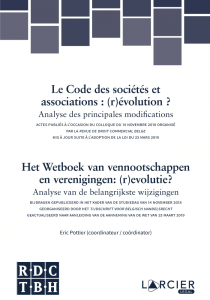
Over het Wetboek van vennootschappen en verenigingen (en stichtingen) is al heel wat goede rechtsleer verschenen. Aan de steeds uitdijende bibliotheek kan een nieuw boek toegevoegd worden. De fine fleur van de Belgische specialisten hebben het WVV geanalyseerd en hun bevindingen gebundeld in een boek dat zonet verschenen is bij Larcier (de bijdragen werden eerder reeds gepubliceerd in de bijzondere nummers 9 en 10 van jaargang 2018 TBH/RDC, vanzelfsprekend na stemming van de wet van 23 maart 2019 door de Kamer). Continue reading “Het Wetboek van vennootschappen en verenigingen: (r)evolutie ?”
Aanbevolen (zomer)lectuur
De zomerperiode is het ideale moment om nieuwe inzichten op te doen. Recent zijn twee boeken verschenen die daartoe zeker de nodige inspiratie leveren. Het eerste boek is van de hand van professor Pistor (Columbia University) en is getiteld The Code of Capital How the Law Creates Wealth and Inequality. Het tweede boek is de monumentale studie van professor Cornelis (VUB) gewijd aan de openbare orde. Continue reading “Aanbevolen (zomer)lectuur”
Donkere wolken boven GROG: het arrest Plessers
In het jongste nummer van de Juristenkrant (nr. 391, 12 juni 2019) bespreken Stan Brijs en ik het arrest Plessers (zie hierover eerder op deze blog). Dit arrest stelt de verhouding tussen het insolventierecht en het arbeidsrecht op scherp. Continue reading “Donkere wolken boven GROG: het arrest Plessers”
New rules on business insolvency adopted
Yesterday, the Council of the European Union formally adopted today the directive on preventive restructuring frameworks, second chance and measures to increase the efficiency of restructuring, insolvency and discharge procedures. The European Parliament formally voted on the directive on 28 March 2019. This marks the end of the legislative procedure. Continue reading “New rules on business insolvency adopted”
Belgische Corporate Governance Code 2020
De nieuwe Belgische Corporate Governance Code 2020 is vandaag voorgesteld. De code is van toepassing op vennootschappen naar Belgisch recht waarvan de aandelen verhandeld worden op een gereglementeerde markt (‘genoteerde vennootschappen’) zoals gedefinieerd in het Wetboek van vennootschappen en verenigingen. Continue reading “Belgische Corporate Governance Code 2020”
 Corporate Finance Lab