Call for proposals: Corporate & Organizational Decision-Making

By: Business & Liability Research Network (Leiden University)

The Business & Liability Research Network (BLRN) – a partnership between the Company Law department and the Business Studies department of the Leiden Law School – is launching its call for proposals for a new book project on the topic of Corporate & Organizational Decision-Making.

The Business & Liability Research Network

BLRN focuses on innovative and multidisciplinary research in the areas of (i) Good Corporate Governance, (ii) Distress & Insolvency and (iii) Future Business Structures. It was launched in 2018 with an opening conference on “Business Resilience”, which proved to be the prelude to a successful first year.

The network offers the possibility to bring together different research areas (legal and business research) as well as practice and the academic world, leading to innovative perspectives on current issues.

BLRN Book Project

The topic of decision-making in corporations and organizations is receiving increased attention due to the impact of technological developments, discussions on corporate governance and practical examples of (inadequate) decision-making processes. In this project, BLRN aims to highlight corporate & organizational decision-making from a multidisciplinary perspective. From both a legal and business perspective, research will be conducted within the sphere of the three research areas of BLRN: (i) Good Corporate Governance, (ii) Distress & Insolvency and (iii) Future Business Structures. This includes, for example, the relationship between corporate governance and entrepreneurship, the way in which various actors should act during insolvency and the impact of technological developments on a company. Continue reading “Call for proposals: Corporate & Organizational Decision-Making”
De maatschap: enkele praktische knelpunten na ruim 2000 jaar

Studienamiddag donderdag 24 oktober 2019, KU Leuven Campus Brussel (Leerstoel Constant Matheeussen)

De maatschap is onze oudste vennootschapsvorm en nog steeds de vennootschap ‘van gemeen recht’. Zij is polyvalent, flexibel, discreet, fiscaalvriendelijk en daarom vooral  sinds de jaren ’90 een zeer ‘gewild’ instrument van successieplanning.

Maar blijft dit wel zo?

Continue reading “De maatschap: enkele praktische knelpunten na ruim 2000 jaar”

The New Bargaining Theory of Corporate Bankruptcy and Chapter 11’s Renegotiation Framework

A post by guest blogger Professor Anthony J. Casey (University of Chicago)

The prevailing theory of corporate bankruptcy law states that its purpose is to vindicate or mimic the agreement that creditors would have reached if they had bargained with each other to write their own rules. That idea – the Creditors’ Bargain theory – has held a central place in the minds of lawyers, judges, and scholars for almost forty years. At the same time, Creditors’ Bargain theorists have struggled to explain what actually prevents creditors from bargaining with each other and how efficient rules that interfere with creditors’ bargained-for rights fit into the theory.

Meanwhile, in other areas of the law, scholars have long recognized the limits of hypothetical contract theories. Notably, scholars have shown that when parties have limited or asymmetric information and incentives to bargain strategically, their contracts will be incomplete in ways that the law cannot remedy with a hypothetical contract. Bankruptcy scholars have never squarely addressed this challenge.

Taking aim at these issues, my article, The New Bargaining Theory of Corporate Bankruptcy and Chapter 11’s Renegotiation Framework, proposes a new law-and-economics theory of corporate bankruptcy. Continue reading “The New Bargaining Theory of Corporate Bankruptcy and Chapter 11’s Renegotiation Framework”

Het recht laat zich niet in hokjes plaatsen. Of hoe art. 2:44 W.V.V. de Raad van State zijn rechtsmacht dreigt te ontnemen

Een post door gastblogger Tina Coen (aspirant FWO, VUB)

1. Met de invoering van het Wetboek van Vennootschappen en Verenigingen werd ook het annulatiecontentieux van de ondernemingsrechtbanken hertekend. Tot voor kort beperkte art. 178 W.Venn. de exclusieve bevoegdheid van de ondernemingsrechtbank om besluiten van vennootschapsorganen nietig te verklaren, zich tot besluiten van de algemene vergadering. Voortaan bepaalt art. 2:44 W.V.V. in zijn eerste lid dat “[d]e ondernemingsrechtbank […] de nietigheid van een besluit uit[spreekt] op verzoek van de rechtspersoon of een persoon die belang heeft bij de naleving van de rechtsregel die niet is nagekomen.”

In zuiver vennootschapsrechtelijke context brengt deze herformulering weinig zoden aan de dijk, nu de vennootschapswetgever in essentie niet meer heeft gedaan dan de jurisprudentiële praktijk om ook besluiten van de raad van bestuur per analogiam nietig te verklaren, te bevestigen. Hoogstens wordt de kring van vorderingsgerechtigden voortaan anders omschreven. Het annulatieberoep staat niet langer open voor elke belanghebbende maar enkel voor de vennootschap en personen die belang hebben bij de naleving van de rechtsregel die niet is nagekomen. Hoe die wijziging in de rechtspraak zal worden ontvangen, valt af te wachten, maar is voor deze blogpost minder van belang. Continue reading “Het recht laat zich niet in hokjes plaatsen. Of hoe art. 2:44 W.V.V. de Raad van State zijn rechtsmacht dreigt te ontnemen”

Uitreiking 9de Grote Prijs Jean Bastin aan dr. F. Giansetto voor “Le traitement juridictionnel de l’insolvabilité de l’État”

woensdag 19 juni 2019 te Brussel

Tijdens een academische zitting o.l.v. Prof. Mark Eyskens wordt op  woensdag 19 juni 2019 om 17u te Brussel de 9de Grote Prijs Jean Bastin uitgereikt aan aan dr. Fanny Giansetto voor haar Parijs proefschrift Le traitement juridictionnel de l’insolvabilité de l’État.

Prof. Roland Gillet (Paris 1 – Sorbonne en ULB) zal een uiteenzetting houden over ‘Croissance et endettement : de nos choix individuels aux conséquences collectives.

De uitnodiging met praktische details en inschrijvingsmogelijkheid vindt u hier. Meer informatie over de Grote Prijs Jean Bastin vindt u hier.

Continue reading “Uitreiking 9de Grote Prijs Jean Bastin aan dr. F. Giansetto voor “Le traitement juridictionnel de l’insolvabilité de l’État””

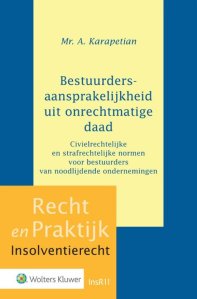
Proefschrift A. Karapetian (Groningen) over bestuurdersaansprakelijkheid uit onrechtmatige daad bij noodlijdende onderneming

9200000105529340Mr. Arpi Karapetian promoveerde op 14 maart 2019 aan de Universiteit van Groningen cum laude op het proefschrift: ‘Bestuurdersaansprakelijkheid uit onrechtmatige daad. Civielrechtelijke en strafrechtelijke normen voor bestuurders van noodlijdende ondernemingen’. Deze post bespreekt het onderzoek en gaat in op enkele conclusies m.b.t. het verband tussen het civielrechtelijk en strafrechtelijk normenkader; de beoordeling van selectieve betalingen voorafgaand aan het faillissement; en de beoordeling van de rechtmatigheid van het gedrag van bestuurders bij reddingspogingen.
Het leerstuk van de bestuurdersaansprakelijkheid beslaat een veelheid aan wettelijke en niet-wettelijke regels en beginselen over een breed palet aan onderwerpen. Er zijn naar Nederlands recht (maar zeker ook in andere jurisdicties) verschillende grondslagen van aansprakelijkheid aan te wijzen voor de bestuurder van een vennootschap. Continue reading “Proefschrift A. Karapetian (Groningen) over bestuurdersaansprakelijkheid uit onrechtmatige daad bij noodlijdende onderneming”

The thinking of Hayek and Schumpeter on the efficiency of markets: similarities and differences

In the essay below, Dieter Van Esbroeck, discusses competing theories on market efficiency of Pareto, Hayek and Schumpeter. The different insights in the operations of the market lead to rather diverging policy recommendations to harvest the gains of free competition and efficiency. His essay won the Montaigne-Essay contest of 2019 organized by the Institute for Education in Philosophy and Social Sciences (Ifese).

Continue reading “The thinking of Hayek and Schumpeter on the efficiency of markets: similarities and differences”

Wanneer ben je een onderneming?

Ben je een ondernemer wanneer je online oude fietsen verkoopt? En hoe zit dat dan fiscaal? Continue reading “Wanneer ben je een onderneming?”

Invoeringswet WVV gepubliceerd

In het Belgisch Staatsblad van vandaag (2019-04-04) verscheen de Wet van 23 maart 2019 tot invoering van het Wetboek van vennootschappen en verenigingen en houdende diverse bepalingen (blz. 33239).

“Het insolventierecht permanent in de steigers”

Oratie door Professor Eric Dirix bij toelating tot het emeritaat beschikbaar

Bij Intersentia verscheen in de reeks Acta Falconis de oratie die Professor Eric Dirix uitsprak bij de toelating tot het emeritaat: Het insolventierecht permanent in de steigers. Deze oratie is ook hier te consulteren via de website van de Leuvense Faculteit der Rechtsgeleerdheid. Het boekje bevat ook de laudatio uitgesproken door Professor Vincent Sagaert.

Opmerkelijk in deze rede is het pleidooi voor een minder aandeelhoudersvriendelijk insolventierecht: Continue reading ““Het insolventierecht permanent in de steigers””

Belgische wetgever maakt verregaande controle mogelijk van overeenkomsten en praktijken tussen ondernemingen

Een post door gastblogger professor Evelyne Terryn (KU Leuven)

Op 21 maart 2019 heeft de voltallige Kamer het wetsvoorstel tot wijziging van het WER met betrekking tot misbruiken van economische afhankelijkheid, onrechtmatige bedingen en oneerlijke marktpraktijken goedgekeurd. Deze wet is onder de radar gebleven hoewel hij een ingrijpende hervorming inhoudt van het ondernemingsrecht en het verbintenissenrecht en een verregaande controle toelaat van praktijken en overeenkomsten tussen ondernemingen. Continue reading “Belgische wetgever maakt verregaande controle mogelijk van overeenkomsten en praktijken tussen ondernemingen”

The Debate on the Preventive Restructuring Directive continues while the vote is near

The message of the post last week on this blog by Professor R.J. de Weijs, A.L. Jonkers and M. Malakotipour of the University of Amsterdam has been replicated by the authors in a Letter to the EP, with a supporting letter by Professor Douglas Baird of The University of Chicago.

Professor Bob Wessels of Leiden has replied to their arguments on his blog.

The draft Directive is up for vote on  27 March 2019.

The CJEU Vantaan kaupunki case: piercing the corporate veil via private enforcement of EU competition law

A post by Jasper Van Eetvelde & Michiel Verhulst

The CJEU judgement on the 14th of March 2019 in the Vantaan kaupunki case shows the increasing spillover effects of the public enforcement of competition law on the private enforcement thereof. The CJEU found that the concept of ‘undertaking’ as autonomously interpreted in competition law is applicable when claiming for damages on the basis of breaches of EU competition law. This has far-reaching consequences, since it implies that both the principles of parental liability and economic continuity are henceforth part of the national rules on the private enforcement of EU competition law. This triggers some reflections on corporate law on voluntary winding-up in general and the usefulness of focussing on the economic reality outside competition law. Continue reading “The CJEU Vantaan kaupunki case: piercing the corporate veil via private enforcement of EU competition law”

A reply to professor Madaus “The new European Relative Priority from the Preventive Restructuring Directive – The end of European Insolvency Law?”

A post by guest bloggers prof. dr. R.J. de Weijs, A.L. Jonkers LLM and M. Malakotipour LLB (University Amsterdam)

On March 26, 2019 the European Parliament will vote on the Preventive Restructuring Framework.

The initial draft Directive from 2016 contained a rule providing the basic protection that shareholders of a financially distressed and reorganized company could not hold on to any value unless the creditors by majority vote consented thereto. Such a rule is in force in US and German law and is referred to as an Absolute Priority Rule (‘APR’). The US has been an important source of inspiration for implementing such a far-reaching reorganization procedure. The Absolute Priority Rule is generally considered to be one of the most important rules of US bankruptcy law, see recently the US Supreme Court in the famous Czyzewski v. Jevic Holding Corp case, calling the APR “quite appropriately, bankruptcy’s most important and famous rule” and “the cornerstone of reorganization practice and theory.”[1]

Without much in-depth analyses or debate, the European Union is about to embark on a wild adventure. It seeks to implement the US reorganization culture, without however the most basic rule of protection. Continue reading “A reply to professor Madaus “The new European Relative Priority from the Preventive Restructuring Directive – The end of European Insolvency Law?””

Uitsluiting en uittreding na faillissement: de aandeelhouder op een zinkend schip ?

Post door gastblogger Robin Olivier Karpiel (student UA)

De procedure tot uitsluiting en uittreding is een populaire manier om geschillen tussen aandeelhouders van een BVBA of een NV te regelen. Conflicten worden zo binnen de vennootschap bij de wortel aangepakt. De uitsluiting (“u moet uw aandelen aan mij verkopen”) en uittreding (“u moet aandelen van mij kopen”) kunnen dankzij de overdracht van aandelen meteen ook de oorsprong van het geschil doen verdwijnen.

In tijden van dreigende insolventie kunnen wortels van conflicten echter zeer diep groeien. Eenmaal geschillen uitvoerig worden uitgespit, kan het voor de vennootschap zelf al te laat zijn en klopt het faillissement mogelijks aan de deur.

Maar wat indien een procedure tot uitsluiting of uittreding op dat moment al is ingesteld? Dient de aandeelhouder, als een kapitein op een zinkend schip, steeds als laatste aan boord van de onderneming te blijven? Of vormt de geschillenregeling de ideale reddingsboei ten tijde van financiële moeilijkheden? Deze en gerelateerde vragen komen aan bod in deze bijdrage.

Daarbij zal niet worden nagelaten om enkele relevante wijzigingen van het (recent goedgekeurde) WVV mee te nemen. Continue reading “Uitsluiting en uittreding na faillissement: de aandeelhouder op een zinkend schip ?”