Limits to Group Structures and Asset Partitioning in Insolvency

The 800-Pound Gorilla. Limits to Group Structures and Asset Partitioning in Insolvency, Preadviezen / Reports 2018

The website of the Netherlands Association for Comparative and International Insolvency Law (NACIIL) has published in open access the reports (“preadviezen”) on Limits to Group Structures and Asset Partitioning in Insolvency.

This book contains reports prepared by prof. R. Squire (US), prof. J. Vananroye, A. van Hoe and dr. G. Lindemans (Belgium), prof. F.M.J. Verstijlen and A. Karapetian (Netherlands) and A.L. Jonkers (Netherlands). From the introduction to reports by the NACIIL board:

“In insolvency procedures, administrators have to accept the estate as they find it. Furthermore, administrators are commonly appointed in the proceeding as to a specific legal entity and have to respect the separate legal personality. By means of limited liability and separate legal personality, groups can incorporate in ways where liabilities and assets are allocated in different legal entities. This creates room for opportunism, especially in relation to creditors.

The 2018 NACIIL annual reports focus on the theme ‘Limits to Group Structures and Asset Partitioning in Insolvency’. This theme encompasses two related topics at the intersection of corporate law and insolvency law: (1) the artificial subdivision of enterprises over different legal entities (asset partitioning) and (2) selective perforation by means of guarantees. Continue reading “Limits to Group Structures and Asset Partitioning in Insolvency”
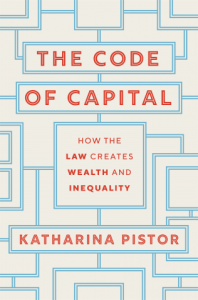
The Code of Capital: How the Law Creates Wealth and Inequality 

KU Leuven Campus Brussels | Monday 4 November 2019

9780691178974Professor Katharina Pistor (Columbia Law School) presents on Monday 4 November 2019 in Brussels her book The Code of Capital on how the law shapes the distribution of wealth.

This book develops i.a. the topics which Professor Pistor touched upon in her Heremans Lectures as Global Law Professor at the KU Leuven in 2016.

“This is a fascinating book that demonstrates how the rights of capital have been entrenched in the international legal system. The Code of Capital opens the way for a thoughtful discussion about the treaties on capital flows and privileges that need to be rewritten. A must-read.”

Thomas Piketty

Programme

16.30: Welcome by Professor Dirk Heremans (emeritus KU Leuven)

16.40: Lecture by Professor Katharina Pistor (Columbia Law School)

17.40: Belgian responses by

  • Professor Koen Geens (KU Leuven and Minister of Justice of Belgium)
  • Professor Ludo Cornelis (emeritus VUB)
  • Professor Joeri Vananroye (KU Leuven)

18.10: Q&A

18.30: End

Venue Continue reading “The Code of Capital: How the Law Creates Wealth and Inequality “

Zijn vennootschapsbestuurders ook ondernemingen?

A. Van Hoe en N. Appermont, “Iedereen onderneming: wat met vennootschapsbestuurders?”, TBH/RDC 2019, 494-503.

Sinds de inwerkingtreding van het nieuwe ondernemingsrecht op 1 november 2018 heeft het de Belgische wetgever het verouderde handelaarsbegrip definitief ten grave gedragen en vervangen door een meer hedendaags ondernemingsbegrip. Enkele maanden vóór datum trad overigens ook het nieuwe insolventierecht (Boek XX WER) in werking. De gevolgen voor de rechtspraktijk zijn groot.

In de kielzog van deze wetgevende omwenteling rijzen echter verschillende vragen. Eén van deze vragen betreft de positie van de vennootschapsbestuurder[1] binnen het nieuwe ondernemingsrecht. Is de vennootschapsbestuurder ook een onderneming? En welke juridische gevolgen zou het kleven van het juridisch etiket op het voorhoofd van de vennootschapsbestuurder hebben? Kan een vennootschapsbestuurder dan ook failliet worden verklaard? Deze vragen hebben inmiddels reeds aanleiding gegeven tot uiteenlopende rechtspraak.[2]

Belang

Het antwoord op deze vragen is voor de rechtspraktijk niet zonder belang. Hoewel men op het eerste gezicht zou kunnen denken dat een vennootschapsbestuurder het faillissement te allen prijzen zou willen vermijden, gaat deze redenering in de brave new world van het ondernemingsrecht niet meer steeds op. Continue reading “Zijn vennootschapsbestuurders ook ondernemingen?”

Call for proposals: Corporate & Organizational Decision-Making

By: Business & Liability Research Network (Leiden University)

The Business & Liability Research Network (BLRN) – a partnership between the Company Law department and the Business Studies department of the Leiden Law School – is launching its call for proposals for a new book project on the topic of Corporate & Organizational Decision-Making.

The Business & Liability Research Network

BLRN focuses on innovative and multidisciplinary research in the areas of (i) Good Corporate Governance, (ii) Distress & Insolvency and (iii) Future Business Structures. It was launched in 2018 with an opening conference on “Business Resilience”, which proved to be the prelude to a successful first year.

The network offers the possibility to bring together different research areas (legal and business research) as well as practice and the academic world, leading to innovative perspectives on current issues.

BLRN Book Project

The topic of decision-making in corporations and organizations is receiving increased attention due to the impact of technological developments, discussions on corporate governance and practical examples of (inadequate) decision-making processes. In this project, BLRN aims to highlight corporate & organizational decision-making from a multidisciplinary perspective. From both a legal and business perspective, research will be conducted within the sphere of the three research areas of BLRN: (i) Good Corporate Governance, (ii) Distress & Insolvency and (iii) Future Business Structures. This includes, for example, the relationship between corporate governance and entrepreneurship, the way in which various actors should act during insolvency and the impact of technological developments on a company. Continue reading “Call for proposals: Corporate & Organizational Decision-Making”

The New Bargaining Theory of Corporate Bankruptcy and Chapter 11’s Renegotiation Framework

A post by guest blogger Professor Anthony J. Casey (University of Chicago)

The prevailing theory of corporate bankruptcy law states that its purpose is to vindicate or mimic the agreement that creditors would have reached if they had bargained with each other to write their own rules. That idea – the Creditors’ Bargain theory – has held a central place in the minds of lawyers, judges, and scholars for almost forty years. At the same time, Creditors’ Bargain theorists have struggled to explain what actually prevents creditors from bargaining with each other and how efficient rules that interfere with creditors’ bargained-for rights fit into the theory.

Meanwhile, in other areas of the law, scholars have long recognized the limits of hypothetical contract theories. Notably, scholars have shown that when parties have limited or asymmetric information and incentives to bargain strategically, their contracts will be incomplete in ways that the law cannot remedy with a hypothetical contract. Bankruptcy scholars have never squarely addressed this challenge.

Taking aim at these issues, my article, The New Bargaining Theory of Corporate Bankruptcy and Chapter 11’s Renegotiation Framework, proposes a new law-and-economics theory of corporate bankruptcy. Continue reading “The New Bargaining Theory of Corporate Bankruptcy and Chapter 11’s Renegotiation Framework”

WHOA! Een eerste analyse van de voorgestelde Nederlandse reorganisatieprocedure

Inspiratie voor België?

Gisteren verscheen het Nederlandse voorstel van wet homologatie onderhands akkoord (hierna: WHOA). De WHOA komt er naar aanleiding van de versterking van het reorganiserend vermogen van bedrijven. Het akkoord dat onder de surseance van betaling kon worden aangeboden, bleek immers geen succesvol reorganisatie-instrument. Eén van de voornaamste redenen daarvoor is dat de surseance enkel werkt ten aanzien van concurrente schuldeisers, terwijl concurrente schuldeisers in een faillissement sowieso maar weinig tot niets meer krijgen. De schuldeisers met een voorrecht zoals werknemers, de fiscus en separatisten die in een faillissement het grootste deel van de koek krijgen, kunnen daarentegen ook tijdens de surseance hun zekerheidsrechten blijven uitwinnen.

De WHOA introduceert als het ware een échte reorganisatieprocedure in het Nederlandse recht, die kan worden aangewend zodra de schuldenaar verkeert in een toestand waarin redelijkerwijs aannemelijk is dat hij met het betalen van zijn schulden niet zal kunnen voortgaan (art. 370, lid 1 Fw). De voorgestelde procedure is gebaseerd op de Engelse scheme of arrangement en de Amerikaanse Chapter 11. Daarenboven beoogt zij consistent te zijn met de recent gepubliceerde Europese richtlijn betreffende herstructurering en insolventie (hierna: de Europese richtlijn).

Een volledige artikelsgewijze bespreking van de WHOA gaat de opzet van een blogpost te buiten. We beperken ons dus tot een summiere bespreking van enkele van de voornaamste principes. Hier en daar plaatsen we enkele kanttekeningen. Continue reading “WHOA! Een eerste analyse van de voorgestelde Nederlandse reorganisatieprocedure”

Nederlandse voorstellen ‘Wet overgang van onderneming in faillissement’ – Wat met werknemersbescherming na Smallsteps en Plessers?

Consultatieronde van start

Op 29 mei 2019 verschenen de Nederlandse voorstellen voor een wet en ministeriële regeling “overgang van onderneming in faillissement”. Die voorstellen zijn er gekomen naar aanleiding van de uitspraak van het Europees Hof van Justitie in de zaak Smallsteps. Daarin werd geoordeeld dat de Nederlandse pre-packpraktijk niet richtlijnconform is. De Nederlandse voorstellen kunnen ter inspiratie dienen voor de Belgische wetgever bij het opstellen van een meer coherente en richtlijnconforme regelgeving inzake werknemersbescherming bij (i) de overdracht van een onderneming uit faillissement en (ii) de gerechtelijke reorganisatie door overdracht onder gerechtelijk gezag (hierna: ‘GROG’). Continue reading “Nederlandse voorstellen ‘Wet overgang van onderneming in faillissement’ – Wat met werknemersbescherming na Smallsteps en Plessers?”

Aandeelhouder beschikt ook na afsluiting faillissement niet over zelfstandige vordering voor afgeleide schade

Cass. 10 mei 2019 (C.17.03.97.N) gaat verder op de ingeslagen weg

Dat het leerstuk van de afgeleide schade van een aandeelhouder voor sommigen nog niet aan zijn laatste episode was toegekomen, bewijst een uitspraak van het Hof van Cassatie op 10 mei 2019.

Wat we reeds wisten: indien een derde schade berokkent aan een vennootschap, beschikt een individuele aandeelhouder van die vennootschap voor zijn afgeleide schade niet over een vorderingsrecht ten aanzien van de foutieve derde, ook al stelt de vennootschap of de curator, na faillissement van de vennootschap, zelf geen vordering in. Continue reading “Aandeelhouder beschikt ook na afsluiting faillissement niet over zelfstandige vordering voor afgeleide schade”

The ECJ in ‘Plessers’: Employee Protection in Insolvency Proceedings by Transfer of Undertaking

In search of the right balance between employee protection and efficiency of insolvency proceedings

In its preliminary ruling of today, the ECJ has followed its AG and decided that Council Directive 2001/23/EC (the ‘Directive’) must be interpreted as precluding national legislation, such as Article 61(3) of the Belgian WCO (now Article XX.86(3) WER), which, in the event of the transfer of an undertaking which has taken place in the context of proceedings for judicial restructuring by transfer under judicial supervision (‘GROG’) applied with a view to maintaining all or part of the transferor or its activity, entitles the transferee to choose the employees which it wishes to keep on.

On 23 April 2012, NV Echo entered into a judicial reorganisation proceeding. A collective agreement could not be reached and on 19 February 2013, a GROG was initiated. On 22 April 2013, NV Prefaco took over the business of NV Echo together with two-thirds of the total employees of the transferor.

Plessers, who was one of the dismissed employees, argued (among other things) that Continue reading “The ECJ in ‘Plessers’: Employee Protection in Insolvency Proceedings by Transfer of Undertaking”

Over het recht op informatie van de schuldeiser die optreedt als ‘boedelberrederaar’

Eén jaar na de invoering van art. XX.225, §3 WER

Indien we het insolventielandschap met een staatsvorm zouden moeten vergelijken, komt het verlicht despotisme wellicht het dichtst in de buurt.[1] De curator die door een hogere macht (de rechtbank) wordt aangeduid om over het insolventielandschap te regeren, stelt alles in het werk om de belangen van de onderdanen (de schuldeisers) zo goed mogelijk te dienen. De schuldeisers zelf hebben en cours de route weinig inspraak in het beleid van de curator. Rekening en verantwoording door de curator vindt immers slechts plaats op de sluitingsvergadering (art. XX.170 WER). Continue reading “Over het recht op informatie van de schuldeiser die optreedt als ‘boedelberrederaar’”

“Het insolventierecht permanent in de steigers”

Oratie door Professor Eric Dirix bij toelating tot het emeritaat beschikbaar

Bij Intersentia verscheen in de reeks Acta Falconis de oratie die Professor Eric Dirix uitsprak bij de toelating tot het emeritaat: Het insolventierecht permanent in de steigers. Deze oratie is ook hier te consulteren via de website van de Leuvense Faculteit der Rechtsgeleerdheid. Het boekje bevat ook de laudatio uitgesproken door Professor Vincent Sagaert.

Opmerkelijk in deze rede is het pleidooi voor een minder aandeelhoudersvriendelijk insolventierecht: Continue reading ““Het insolventierecht permanent in de steigers””

The Debate on the Preventive Restructuring Directive continues while the vote is near

The message of the post last week on this blog by Professor R.J. de Weijs, A.L. Jonkers and M. Malakotipour of the University of Amsterdam has been replicated by the authors in a Letter to the EP, with a supporting letter by Professor Douglas Baird of The University of Chicago.

Professor Bob Wessels of Leiden has replied to their arguments on his blog.

The draft Directive is up for vote on  27 March 2019.

A reply to professor Madaus “The new European Relative Priority from the Preventive Restructuring Directive – The end of European Insolvency Law?”

A post by guest bloggers prof. dr. R.J. de Weijs, A.L. Jonkers LLM and M. Malakotipour LLB (University Amsterdam)

On March 26, 2019 the European Parliament will vote on the Preventive Restructuring Framework.

The initial draft Directive from 2016 contained a rule providing the basic protection that shareholders of a financially distressed and reorganized company could not hold on to any value unless the creditors by majority vote consented thereto. Such a rule is in force in US and German law and is referred to as an Absolute Priority Rule (‘APR’). The US has been an important source of inspiration for implementing such a far-reaching reorganization procedure. The Absolute Priority Rule is generally considered to be one of the most important rules of US bankruptcy law, see recently the US Supreme Court in the famous Czyzewski v. Jevic Holding Corp case, calling the APR “quite appropriately, bankruptcy’s most important and famous rule” and “the cornerstone of reorganization practice and theory.”[1]

Without much in-depth analyses or debate, the European Union is about to embark on a wild adventure. It seeks to implement the US reorganization culture, without however the most basic rule of protection. Continue reading “A reply to professor Madaus “The new European Relative Priority from the Preventive Restructuring Directive – The end of European Insolvency Law?””

Uitsluiting en uittreding na faillissement: de aandeelhouder op een zinkend schip ?

Post door gastblogger Robin Olivier Karpiel (student UA)

De procedure tot uitsluiting en uittreding is een populaire manier om geschillen tussen aandeelhouders van een BVBA of een NV te regelen. Conflicten worden zo binnen de vennootschap bij de wortel aangepakt. De uitsluiting (“u moet uw aandelen aan mij verkopen”) en uittreding (“u moet aandelen van mij kopen”) kunnen dankzij de overdracht van aandelen meteen ook de oorsprong van het geschil doen verdwijnen.

In tijden van dreigende insolventie kunnen wortels van conflicten echter zeer diep groeien. Eenmaal geschillen uitvoerig worden uitgespit, kan het voor de vennootschap zelf al te laat zijn en klopt het faillissement mogelijks aan de deur.

Maar wat indien een procedure tot uitsluiting of uittreding op dat moment al is ingesteld? Dient de aandeelhouder, als een kapitein op een zinkend schip, steeds als laatste aan boord van de onderneming te blijven? Of vormt de geschillenregeling de ideale reddingsboei ten tijde van financiële moeilijkheden? Deze en gerelateerde vragen komen aan bod in deze bijdrage.

Daarbij zal niet worden nagelaten om enkele relevante wijzigingen van het (recent goedgekeurde) WVV mee te nemen. Continue reading “Uitsluiting en uittreding na faillissement: de aandeelhouder op een zinkend schip ?”

Frederik De Leo about Plessers-case on ‘Oxford Business Law Blog’

The day after the ECJ’s AG Szpunar delivered his opinion in the case Plessers, a first analysis by Frederik De Leo was published on the Corporate Finance Lab (see here). Other versions of this blog post have now appeared on the Oxford Business Law Blog (in English) and in ‘De Juristenkrant’ (in Dutch).

In these other versions, the author discusses the possible consequences of the ECJ following its AG’s opinion from a comparative perspective. In this context, the author observes the following: Continue reading “Frederik De Leo about Plessers-case on ‘Oxford Business Law Blog’”