Save the date: studie-avond ‘Grondige Studie insolventierecht’ UA op 18 december 2019

Naar jaarlijkse traditie organiseren de studenten van de Grondige Studie insolventierecht aan de Universiteit Antwerpen opnieuw een studie-avond, onder begeleiding van prof. dr. Stijn De Dier en prof. dr. Melissa Vanmeenen. Op de (reeds) twaalfde editie van deze studie-avond worden specifieke thema’s belicht binnen het ruime speelveld van zekerheden in het insolventierecht. Uiteraard blijven recente wetswijzigingen of tendensen in de rechtspraak daarbij niet achterwege.

De studie-avond gaat door op woensdag 18 december 2019 om 19u in aula R.002 Stadscampus UA, Rodestraat 14, Antwerpen (gebouw R; klik hier voor een plan). Deelname is gratis en iedereen is welkom.

Een uitgebreider programma volgt na de selectie van studenten die hun essay mogen presenteren.

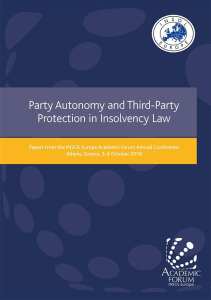
Party Autonomy and Third-Party Protection in Insolvency Law

Papers from the INSOL Europe Academic Forum Annual Conference Athens, Greece, 3-4 October 2018

69356918_2596135720425106_922483357986586624_n - kopie (002)From 24 to 29 September 2019, the Inaugural YANIL Conference at 10 Years, the INSOL Europe Academic Forum and the INSOL Europe Annual Congress took place in Copenhagen, Denmark. The main topic of these conferences was the recently adopted European Restructuring Directive (what else?).


We will not try to summarise these discussions (a full report by Myriam Mailly, Jennifer Gant and Paul Omar will appear in the next edition of Eurofenix). We will try, however, to draw attention to the conference proceedings booklet of the Academic Forum 2018 which took place in Athens, Greece and which was published during this year’s conference. The topic of last year’s conference was “Party Autonomy and Third-Party Protection in Insolvency Law”, hence the title of this booklet. Continue reading “Party Autonomy and Third-Party Protection in Insolvency Law”

Studiedag 1 jaar nieuw ondernemingsrecht

Studiedag – 20 december – UHasselt

Ter ere van het éénjarig bestaan van het nieuwe ondernemingsrecht wordt op vrijdag 20 december 2019 aan de UHasselt de studiedag ‘1 jaar nieuw ondernemingsrecht‘ georganiseerd.

Zoals geweten is op 1 november 2018 is het begrip ‘koopman’ uit het Belgische rechtsbestel verdwenen en daarmee ook het geheel van regels dat gekend stond als het ‘handelsrecht’. Sinds deze datum, nu reeds één jaar geleden, wordt gesproken over het ‘ondernemingsrecht’ en staat een nieuw begrip, de onderneming, centraal. Deze juridische omwenteling, die overigens gepaard ging met verschillende andere hervormingen van het economisch recht, doet een jaar na haar inwerkingtreding nog verschillende vragen rijzen.

Samen met een aantal experten ter zake uit de magistratuur, advocatuur en de academische wereld worden deze vragen gedurende deze studienamiddag diepgaand onder de loep genomen.

Inschrijven kan via deze link

Continue reading “Studiedag 1 jaar nieuw ondernemingsrecht”

Eyes on Insolvency 2019: een verslag

Een post door gastblogger Eline Van de Velde (student Universiteit Antwerpen)

Op 1 november 2019 vond het congres Eyes on Insolvency 2019 plaats in Amsterdam. Alle presentaties en overige congresmaterialen zijn hier terug te vinden.  Centraal stond het voorontwerp Wet homologatie onderhands akkoord (hierna: WHOA). De aftrap werd gegeven door ons mee te nemen naar het verleden. In 2012 ging men van start met het programma ‘Herijking Faillissementsrecht’ en werd het verlangen geuit naar een akkoord buiten insolventie dat kan worden opgedrongen aan schuldeisers.

Het wetgevingstraject is sterk beïnvloed geweest door Europese initiatieven. De Nederlandse wetgever staat nu voor de keuze om de herstructureringsrichtlijn (aangenomen op 20 juni 2019) ofwel te implementeren in de WHOA, ofwel in de sursaenceregeling. De implementatie in de WHOA zou een redelijk voor de hand liggende keuze zijn, aangezien deze (op enkele punten na) geen aanpassing zou behoeven om in overeenstemming te zijn met de Richtlijn. Er zijn echter ook argumenten om deze te implementeren in de surseanceregeling. Op die manier zou deze regeling versterkt kunnen worden met een effectieve akkoordregeling, waar in de literatuur al geruime tijd voor gepleit wordt. Daarnaast zou de WHOA van eventuele onwenselijke aanpassingen gespaard blijven.[1] Continue reading “Eyes on Insolvency 2019: een verslag”

Discrimineren mag (meestal, in het insolventierecht)

Ons insolventierecht vindt discriminatie doorgaans prima. Zo mag een schuldenaar in principe een van zijn schuldeisers eerder betalen dan de anderen, zelfs al bestaan er tussen hen geen “wettige redenen van voorrang”. Ook staat het een schuldenaar vrij om aan een schuldeiser een zakelijke zekerheid te verlenen, zoals een pand of hypotheek. Hij heeft daarvoor in de regel geen toestemming nodig van de andere, minder fortuinlijke schuldeisers. Evenmin hoeft hij daarvoor een door ons recht aanvaarde verantwoording kunnen bieden.

Continue reading “Discrimineren mag (meestal, in het insolventierecht)”

Zal het insolventierecht de wereld redden?

“Over de schutting” | Oratie gehouden op 1 april 2019 te Leiden ter gelegenheid van de TPR Wisselleerstoel (8)

Eerdere posts schonken aandacht aan enkele technologieën om de scherpe kantjes van afgescheiden vermogen en beperkte aansprakelijkheid af te vijlen: publiciteit, en uitkeringsverplichtingen, uitkeringsbeperkingentoerekeningsregels voor vennootschapsschuldenbestuursaansprakelijkheid.

Deze technologieën staan onder druk. Het internationaalrechtelijk aanknopingspunt voor deze regels wordt immers in belangrijke mate bepaald door het het toepasselijke vennootschapsrecht: de lex societatis. In België gold dat je het toepasselijk vennootschapsrecht niet vrij kan kiezen: je moet het recht kiezen van het economische zwaartepunt van de vennootschap, de werkelijke zetel. Vanuit het idee dat de rechtspersoon in belangrijke mate een figuur met derdenwerking is, vind ik het geen gek idee dat de insiders niet totaal vrij kunnen kiezen. Bij een contract ligt vrije keuze voor de hand; bij figuren met derdenwerking dringt een objectieve aanknopingsfacor zich op. In het goederenrecht is dit de lex rei sitae, de plaats waar een zaak zich werkelijk bevindt, in het vennootschapsrecht is dat de werkelijke zetel. De keuze om vrij het toepasselijk recht te kiezen voor figuren die tegenwerpelijk zijn aan derden wordt in The Code of Capital van Pistor terecht als zeer problematisch beschreven. Continue reading “Zal het insolventierecht de wereld redden?”

Cash pooling: 7 tips om bestuurdersaansprakelijkheid te vermijden

Vooraleer een groepsvennootschap deelneemt aan een cash pool, moet ze nagaan of dit in haar belang is. Indien dit niet zo is, dreigt bestuurdersaansprakelijkheid (I). Ook lopende de cash-pooling-overeenkomst moeten de bestuurders de vinger aan de pols van het vennootschapsbelang houden, zeker indien er solvabiliteitsproblemen ontstaan binnen de groep (II). Om het risico op een schending van het vennootschapsbelang te verkleinen, kan men een aantal richtlijnen in acht nemen bij het vormgeven van de cash pool (III). Continue reading “Cash pooling: 7 tips om bestuurdersaansprakelijkheid te vermijden”

Cashpooling bij nakende insolventie

Opiniebijdrage door Sofie Cools & Joeri Vananroye

Deze post verscheen eerder op 11 oktober 2019 als een opiniebijdrage op De Tijd.

Bestuurders van een Belgische dochtervennootschap van Thomas Cook zouden enkele miljoenen euro hebben doorgestort naar de Britse moedervennootschap kort voor haar faillissement.  Volgens de berichtgeving in de pers was de transfert het gevolg van een systeem van cashpooling.

Cashpooling is een afspraak tussen vennootschappen, doorgaans van eenzelfde groep, dat wanneer één van hen cash op overschot heeft, zij dat ter beschikking stelt aan een andere vennootschap in de cash pool die op dat ogenblik geld nodig heeft. Dat gebeurt via een centrale rekening, meestal op naam van de moedervennootschap.

Cashpooling is niet verboden, en maar goed ook. Cashpooling heeft namelijk grote voordelen. Door mekaar onderling geld te lenen, kunnen groepsvennootschappen vermijden dat ze interesten moeten betalen aan de bank voor sommen die bij een andere vennootschap ongebruikt op de rekening staan. De interest die de ene vennootschap betaalt om te lenen is normaal hoger dan de interest die de andere vennootschap op haar rekening ontvangt; het verschil is winst voor de groep.

Delicaat Continue reading “Cashpooling bij nakende insolventie”

WHOA – Revolutie in de insolventiepraktijk

Congres EYE Amsterdam, 1 november 2019

Op 1 oktober jl. is het verslag gepubliceerd met de inbreng van de Tweede Kamer van het Nederlandse parlement op het Wetsvoorstel Homologatie Onderhands Akkoord (WHOA). Het Kamerstuk (TK, 35249, nr. 5) is te vinden op de website van de Tweede Kamer. Het antwoord van de Minister wordt in de loop van de komende maand verwacht.

Ook voor de Belgische insolventiegemeenschap is dit wetsvoorstel interessant. Continue reading “WHOA – Revolutie in de insolventiepraktijk”

The Road Towards Good Bankruptcy Governance: A Comparative Law and Economics Perspective

Papers from the INSOL Europe Academic Forum Annual Conference Athens, Greece, 3-4 October 2018

In the recently issued conference proceedings booklet “Party-Autonomy and Third Party Protection in Insolvency Law”, I published a paper called “The Road Towards Good Bankruptcy Governance: A Comparative Law and Economics Perspective”. The paper seeks to start the discussion on the topic of good bankruptcy (or insolvency) governance and to inspire idealistic researchers to become involved in this discussion. Three key aspects of good bankruptcy governance were dealt with in this paper.

First, an attempt was made to define the concept of “good bankruptcy governance”. This was later narrowed down to the following question: “In whose interest should the management of a corporation or insolvency estate act?”. A short comparative analysis of the US, the UK, Belgium and the Netherlands did not provide a clear answer.

However, some room for common ground could be found by Continue reading “The Road Towards Good Bankruptcy Governance: A Comparative Law and Economics Perspective”

Limits to Group Structures and Asset Partitioning in Insolvency

The 800-Pound Gorilla. Limits to Group Structures and Asset Partitioning in Insolvency, Preadviezen / Reports 2018

The website of the Netherlands Association for Comparative and International Insolvency Law (NACIIL) has published in open access the reports (“preadviezen”) on Limits to Group Structures and Asset Partitioning in Insolvency.

This book contains reports prepared by prof. R. Squire (US), prof. J. Vananroye, A. van Hoe and dr. G. Lindemans (Belgium), prof. F.M.J. Verstijlen and A. Karapetian (Netherlands) and A.L. Jonkers (Netherlands). From the introduction to reports by the NACIIL board:

“In insolvency procedures, administrators have to accept the estate as they find it. Furthermore, administrators are commonly appointed in the proceeding as to a specific legal entity and have to respect the separate legal personality. By means of limited liability and separate legal personality, groups can incorporate in ways where liabilities and assets are allocated in different legal entities. This creates room for opportunism, especially in relation to creditors.

The 2018 NACIIL annual reports focus on the theme ‘Limits to Group Structures and Asset Partitioning in Insolvency’. This theme encompasses two related topics at the intersection of corporate law and insolvency law: (1) the artificial subdivision of enterprises over different legal entities (asset partitioning) and (2) selective perforation by means of guarantees. Continue reading “Limits to Group Structures and Asset Partitioning in Insolvency”

The Code of Capital: How the Law Creates Wealth and Inequality 

KU Leuven Campus Brussels | Monday 4 November 2019

9780691178974Professor Katharina Pistor (Columbia Law School) presents on Monday 4 November 2019 in Brussels her book The Code of Capital on how the law shapes the distribution of wealth.

This book develops i.a. the topics which Professor Pistor touched upon in her Heremans Lectures as Global Law Professor at the KU Leuven in 2016.

“This is a fascinating book that demonstrates how the rights of capital have been entrenched in the international legal system. The Code of Capital opens the way for a thoughtful discussion about the treaties on capital flows and privileges that need to be rewritten. A must-read.”

Thomas Piketty

Programme

16.30: Welcome by Professor Dirk Heremans (emeritus KU Leuven)

16.40: Lecture by Professor Katharina Pistor (Columbia Law School)

17.40: Belgian responses by

  • Professor Koen Geens (KU Leuven and Minister of Justice of Belgium)
  • Professor Ludo Cornelis (emeritus VUB)
  • Professor Joeri Vananroye (KU Leuven)

18.10: Q&A

18.30: End

Venue Continue reading “The Code of Capital: How the Law Creates Wealth and Inequality “

Zijn vennootschapsbestuurders ook ondernemingen?

A. Van Hoe en N. Appermont, “Iedereen onderneming: wat met vennootschapsbestuurders?”, TBH/RDC 2019, 494-503.

Sinds de inwerkingtreding van het nieuwe ondernemingsrecht op 1 november 2018 heeft het de Belgische wetgever het verouderde handelaarsbegrip definitief ten grave gedragen en vervangen door een meer hedendaags ondernemingsbegrip. Enkele maanden vóór datum trad overigens ook het nieuwe insolventierecht (Boek XX WER) in werking. De gevolgen voor de rechtspraktijk zijn groot.

In de kielzog van deze wetgevende omwenteling rijzen echter verschillende vragen. Eén van deze vragen betreft de positie van de vennootschapsbestuurder[1] binnen het nieuwe ondernemingsrecht. Is de vennootschapsbestuurder ook een onderneming? En welke juridische gevolgen zou het kleven van het juridisch etiket op het voorhoofd van de vennootschapsbestuurder hebben? Kan een vennootschapsbestuurder dan ook failliet worden verklaard? Deze vragen hebben inmiddels reeds aanleiding gegeven tot uiteenlopende rechtspraak.[2]

Belang

Het antwoord op deze vragen is voor de rechtspraktijk niet zonder belang. Hoewel men op het eerste gezicht zou kunnen denken dat een vennootschapsbestuurder het faillissement te allen prijzen zou willen vermijden, gaat deze redenering in de brave new world van het ondernemingsrecht niet meer steeds op. Continue reading “Zijn vennootschapsbestuurders ook ondernemingen?”

Call for proposals: Corporate & Organizational Decision-Making

By: Business & Liability Research Network (Leiden University)

The Business & Liability Research Network (BLRN) – a partnership between the Company Law department and the Business Studies department of the Leiden Law School – is launching its call for proposals for a new book project on the topic of Corporate & Organizational Decision-Making.

The Business & Liability Research Network

BLRN focuses on innovative and multidisciplinary research in the areas of (i) Good Corporate Governance, (ii) Distress & Insolvency and (iii) Future Business Structures. It was launched in 2018 with an opening conference on “Business Resilience”, which proved to be the prelude to a successful first year.

The network offers the possibility to bring together different research areas (legal and business research) as well as practice and the academic world, leading to innovative perspectives on current issues.

BLRN Book Project

The topic of decision-making in corporations and organizations is receiving increased attention due to the impact of technological developments, discussions on corporate governance and practical examples of (inadequate) decision-making processes. In this project, BLRN aims to highlight corporate & organizational decision-making from a multidisciplinary perspective. From both a legal and business perspective, research will be conducted within the sphere of the three research areas of BLRN: (i) Good Corporate Governance, (ii) Distress & Insolvency and (iii) Future Business Structures. This includes, for example, the relationship between corporate governance and entrepreneurship, the way in which various actors should act during insolvency and the impact of technological developments on a company. Continue reading “Call for proposals: Corporate & Organizational Decision-Making”

The New Bargaining Theory of Corporate Bankruptcy and Chapter 11’s Renegotiation Framework

A post by guest blogger Professor Anthony J. Casey (University of Chicago)

The prevailing theory of corporate bankruptcy law states that its purpose is to vindicate or mimic the agreement that creditors would have reached if they had bargained with each other to write their own rules. That idea – the Creditors’ Bargain theory – has held a central place in the minds of lawyers, judges, and scholars for almost forty years. At the same time, Creditors’ Bargain theorists have struggled to explain what actually prevents creditors from bargaining with each other and how efficient rules that interfere with creditors’ bargained-for rights fit into the theory.

Meanwhile, in other areas of the law, scholars have long recognized the limits of hypothetical contract theories. Notably, scholars have shown that when parties have limited or asymmetric information and incentives to bargain strategically, their contracts will be incomplete in ways that the law cannot remedy with a hypothetical contract. Bankruptcy scholars have never squarely addressed this challenge.

Taking aim at these issues, my article, The New Bargaining Theory of Corporate Bankruptcy and Chapter 11’s Renegotiation Framework, proposes a new law-and-economics theory of corporate bankruptcy. Continue reading “The New Bargaining Theory of Corporate Bankruptcy and Chapter 11’s Renegotiation Framework”